| Table of Contents Page 1 – Introduction Page 1 – Being Cabin Crew Page 2 – Behind the Galley Curtain Page 2 – Employee Mental Health Page 3 – Working Well, Living Better Page 4 – Ex-Police Officer Bart Being Cabin Crew | The Ugly Truth Part 2 |
Working Well, Living Better
On the subject of employee mental health, in 2018, the airline published an article that stated its goal was to create a workplace where employees felt “valued, listened to and supported.” It also claimed that its wellbeing initiatives contributed to “the long term happiness of our people and therefore to the long term health of our business.”
The report spoke of a wellbeing awareness course attended by around 1,600 employees. Its purpose was to equip those who attended with the skills and mindset needed to support employees effectively.
It was basically a mental health awareness course that ran for two days. It was delivered by an external company. I attended a couple of months after returning to work following my absence of almost two years.
I found the first day extremely difficult because I had experienced much of what was being discussed. Some of the exercises were designed to make participants experience the kind of feelings and emotions that someone struggling with their mental health might experience.
I felt unable to participate in several of the exercises. At the end, we were asked to write a letter to someone close to us, thanking them for their love and support and explaining the difference they had made to our lives. The instructors would then post it for us. Having recently lost my dad and with no one else in my life to whom I could write such a letter, the exercise affected me deeply.
A colleague sitting beside me, whom I didn’t know that well, said, “You’re not coming back tomorrow, are you?” The comment took me by surprise. I had already decided that I couldn’t return the following day and replied, “No, I’m not.”
Once home, I sent this email to the manager who organised the course. I had known him for as long as I’d been in the company, and our relationship was warm and friendly.
Good morning [name],
It was lovely to see you yesterday.
I’ve just returned home after today’s course. I didn’t go to the hotel because I won’t be attending tomorrow.
I found the day extremely difficult. Several exercises, especially towards the end of the day, made me feel extremely uncomfortable. I didn’t participate in them, which was noted by both instructors. After one exercise, in response to a question asked by [instructor], I told her and the rest of the room that it had made me feel very uncomfortable.
I said that I appreciated what she was trying to achieve, but that the exercise could have a very different effect depending on what people had going on in their lives at the time. Although it may have been a calm and happy experience for some, that wasn’t the case for me.
Subsequent exercises involved tapping into emotions and trying to evoke various feelings using words chosen from a list. Some were positive and others negative. We were asked to write a list of things for which we were grateful and then write a card to someone as a token of gratitude for something they had done for us.
Exercises like that can be extremely powerful, especially for someone who is not in a good place mentally. They were definitely not right for me at this time.
These exercises can be powerful even for people who have not experienced mental health issues. For me, it was a really unpleasant experience. After I told [instructor] how I felt following one exercise, two crew members approached me afterwards and said that it had also made them feel very uncomfortable.
I’ve fought long and hard to get to where I am today and am proud of myself for having come this far. I love being back at work and doing the job I love. It’s helping enormously with my recovery. Although I enjoy learning new things, I’m definitely not yet at the stage where I can be in a situation in which I’m delving into my deeper emotions, certainly not while at work. The last thing I want to do is close my eyes and be sent on a journey looking for inner peace and tranquillity.
I keep myself occupied and on the go as much as possible, and that has helped me become strong again. Although I relax and take time out for myself, I do that privately and in my own way.
Having experienced a huge amount of trauma in recent years, I have a good understanding of mental health and how it affects different people. It’s great that the company is doing something to bring this subject to the attention of its employees, but I’m not convinced that the two instructors fully understood the effect these exercises could have on people who have experienced mental health issues and are still recovering.
Emotions are extremely powerful, and if you prick them, you have to expect consequences. It’s highly likely that some of those won’t be pleasant. I also didn’t like one instructor referring to the suicides that had recently taken place within the company. I think most of us were fully aware and didn’t need reminding.
I hope you understand where I’m coming from. If you wish to speak to me, I’m around until Sunday, when I fly. I’m more than happy to chat.
Thanks for listening, and I’m sorry that I wasn’t able to complete the course.
Best wishes as always,
Laurence
In his response, he thanked me for my feedback and asked if he could share it with the people running the course. I confirmed that he could.
This email was written on 16 September 2018, three months before my flight with Felix. It shows how fragile my mental health still was, how hard I had fought to return and how important being back at work was to my recovery. It also shows that I had openly raised concerns about the effect these emotionally intense exercises could have on employees still recovering from mental health difficulties.
While writing my blog, I came across a post on LinkedIn from a senior executive, a vice-president of a specialist area of the business.
Writing during Mental Health Awareness Week, he began by expressing the importance of mental health awareness. He spoke of being a champion of mental health and “the care we show for our people every day.” He proudly stated that ten per cent of employees had received Mental Health First Aid training and described efforts to “spread this love company-wide” and raise awareness of the support available.
He also announced the launch of a support group specifically for men, where employees had shared their personal experiences and begun forming meaningful connections. He ended by reassuring employees that “no one needs to go through difficulties alone; we are all in this together.”
I replied by briefly explaining my long career with the company and invited her to read my blog if she had a genuine interest in men’s mental health. I also said that I suspected she was more likely to block me than engage with my story.
By the following day, I was blocked.
After Lana was appointed to investigate Felix’s complaint, she sent me a copy and asked me to respond to each allegation. I had to read it several times to absorb what he had written. At fourteen pages, that wasn’t easy. My dad had died just seventeen days earlier, so this really wasn’t what I needed.
Over the following five days, I responded to every allegation and addressed many statements that were untrue. The complaint recounted so many alleged incidents and went into such extraordinary detail that it was overwhelming. It was unlike anything I had encountered before.
Despite knowing that what he was alleging was untrue, the sheer amount of detail made me question my own recollection. He was gaslighting me, using real encounters distorted with events that didn’t happen. I even began questioning my own recollection.
The initial investigation into Felix’s complaint took place on 9 April 2019, almost four months after our flight. I attended alone, confident that the evidence I had prepared would expose the many inaccuracies and contradictions in his account. Instead, I found every aspect of my judgement, conduct and ability as an Onboard Manager being intensely scrutinised.
During the meeting, I learned for the first time that Felix had been unhappy about not being given the opportunity to work up as Purser. That surprised me, as he had joined the company eleven months earlier and had no previous cabin crew experience. Katrina, whom I selected instead, had flown for thirty years, including twenty as an Onboard Manager, albeit with her previous airline. The significance of this, together with the full details of Felix’s complaint, is explored in my book.
Upon returning home after an incredibly difficult and emotional day, I felt absolute despair. I called in sick the following day and was off work for several weeks. For the first time in my life, I had been reduced to tears while trying to defend myself against allegations that were simply not true. It was deeply humiliating.
The manager conducting the investigation was Lana. Just a few years earlier, she had been an Onboard Manager, the same rank as me. She remained in that position for three years before moving into an office-based role. Two years later, she became a Cabin Crew Manager. At the time of investigating Felix’s complaint, she had been in that position for just over two years.
She left the business four months after our meeting but has since returned and is a manager of another department.
During our meeting, I raised the fact that Felix was a former police officer who had served for eight years, yet all of his allegations were untrue. Lana replied, “He’s not a police officer anymore.”
On 17 June 2019, almost ten weeks after our meeting, I still had not heard anything from Lana. I therefore sent her an email:
“Dear Lana,
Further to your email of 10 May, in which you advised me that you would be in touch ‘next week’, it’s now 17 June, and I have not heard from you or anyone else regarding this matter.
I would like to know the outcome of your investigation.
With kind regards,
Laurence”
Lana did not respond, but the outcome arrived the following day.
Her investigation report consisted of 156 pages and included many documents that I hadn’t seen previously: witness statements from the operating crew, minutes from her meeting with Felix, and all correspondence associated with his complaint.
Her email was dated 18 June 2019. I joined the airline on 18 June 1990.
After reading every word of this needless investigation, which had taken Lana ten weeks to complete, I was shocked to discover that, in their witness statements, three other crew members had made allegations of inappropriate touching. Furthermore, much of what Sybil, Wayne, Trixie and Peter had written was untrue.
I couldn’t believe these were the same people I had flown with. Their statements were rude, personal and offensive. They were also highly critical of my conduct and ability as an Onboard Manager. Yet I had found them all pleasant to fly with. Our outbound flight had been quiet and uneventful, and although our return flight was busy and demanding, everyone was friendly and had worked hard. Nothing had happened that could reasonably explain the hostility directed towards me in their statements.
Something very strange was going on, but I didn’t understand what it was. It just didn’t add up.
Having read all the witness statements, there was a distinct split between the crew. Those written by the crew members who had worked at the back of the aircraft in Economy, alongside Arthur, who had worked up as Purser, were overwhelmingly negative. Those written by the crew members who had worked alongside Felix and me in Business Class were honest and reasonably accurate, considering they had been asked to complete their witness statements almost five months after our flight.
Wayne, who served customers in Premium, between Business Class and Economy, spoke highly of Felix, supported many of his allegations and added several of his own. He also made numerous claims that were not supported by other crew members who worked at the front, and many were inconsistent with the company’s standard operating procedures.
Wayne was the crew member called from standby to join our flight. He arrived at the aircraft while customers were boarding. Working in Premium meant that he worked from the front galley, alongside the crew working in Business Class, which included Felix and me.
I found Wayne’s statement particularly alarming because he had seemed like a nice guy, worked hard and completed his duties to a high standard. I had spoken with him several times during both flights to praise his work. Yet his statement was just as rude and offensive as several of the others. He didn’t have a single good word to say about me.
In his witness statement, Wayne confirmed that he had never met any of the crew on our flight previously.
Lana addressed each of Felix’s twenty allegations individually. In fourteen, she concluded there was “no case to answer”, generally because there was insufficient evidence, no support for his claims, or they were contradicted by other witness statements.
Yet, for almost every point, she added that it should be treated as “a learning for Laurence” or that she would speak to my manager about further guidance or training.
When there is insufficient evidence to support an allegation, the matter should be dismissed and closed. It should not continue to be treated as though the event happened. By repeatedly adding criticism and suggesting that I should learn from what had allegedly taken place, and even recommending development or additional training, Lana reinforced my suspicion that something wasn’t right.
After reading her entire investigation and looking back at the minutes of our meeting, I was not convinced that the matter had been treated fairly or impartially.
With six allegations, including inappropriate touching, found to have a case to answer, the matter was passed to Cabin Crew Manager Hayley. She would conduct the second stage of the grievance process, review the evidence and decide whether each allegation should be upheld or dismissed.
The second-stage meeting with Hayley took place on 15 August 2019, almost eight months after my flight with Felix. This time, I was accompanied by an experienced union rep who had joined the company around the same time as me. Hayley was also supported by Employee Relations Consultant Amanda, who was present during my first meeting with Lana.
The purpose of an Employee Relations Consultant was to take minutes, guide the investigating manager on company procedures where necessary and ensure that the meeting remained fair and legally compliant. Although they could ask questions to clarify something for the record, they should not question the employee about the case. They were required to remain impartial and not support either side.
During my first meeting, I was questioned equally by Lana and Amanda for three hours and twenty-five minutes. That made an already difficult situation even more stressful. We also had to change meeting rooms twice.
The minutes from Felix’s meeting with Lana, which had taken place four days earlier, showed that it lasted two hours and thirty-two minutes. It also showed that the tone of his meeting had been markedly different from mine.
Despite my having responded to each of Felix’s allegations in writing and in considerable detail, nothing I wrote was put to him. Instead, Lana repeatedly said, “I’ll ask Laurence why he found that necessary,” or, “I’ll ask Laurence why he did, or didn’t do, that.” The answers to all of her questions were in the response I had submitted before she met with Felix.
The minutes taken by Amanda were difficult to read, contained many mistakes and, in places, made little sense. I was asked to make corrections and made many. The minutes taken during the second meeting were no better.
Had Amanda focused on taking the minutes instead of continually asking questions, they may well have been far more accurate. It’s difficult to take reliable minutes while also taking an active role in the meeting.
While writing this blog, I looked at Amanda’s LinkedIn profile. What I found was particularly concerning. It stated that she was a qualified employment solicitor who had represented individuals and companies before employment tribunals. Given her background, she should have understood the importance of remaining impartial and producing an accurate record.
At the start of my meeting with Lana, she explained that there were forty-nine points from Felix’s complaint to discuss. Amanda should have understood that a complaint of that size raised concerns about proportionality and credibility, including whether it might be vexatious.
Hayley’s lack of experience during the disciplinary meeting quickly became apparent. At times, she appeared flustered, struggled to find the right words and referred to the wrong set of notes, something that only Sally had noticed.
Amanda was clearly leading the meeting, and asked most of the questions. An adjournment seemed to be called very suddenly, soon after she had said, “I’m trying to guide Hayley.” Once Sally and I had left the room, I said, “She has no idea what she’s doing.” Sally replied, “There are so many straightforward disciplinary matters she could have started with. To give her a case of this complexity involving an Inflight Manager is madness.”
At that time, I was unaware that Hayley had only recently joined the department. Nor was I aware, until several months later, that it was the first disciplinary she had handled.
When a grievance was raised, the Head of Cabin Crew was responsible for allocating the case to a manager within her team.
Hayley took six weeks to complete her investigation. During that time, she did not speak to Felix or any of the operating crew about the allegations they had made. The only people she spoke with were Customer Relations, whom I had already contacted. I had asked them to verify whether several customers with whom Felix claimed to have had lengthy conversations were actually travelling on the aircraft. I suspected they weren’t, and that the conversations had been fabricated.
Felix had even claimed that during one such conversation, with a customer called Iris and her husband, “who was recovering from cancer”, a negative remark had been made about one of my announcements. An announcement which I had denied making.
Customer Relations confirmed that none of the customers Felix had mentioned, all of whom were addressed using their first names, appeared on the flight manifest.
Even though this confirmed that the conversations could not have taken place and that Felix’s account was untrue, Hayley upheld the allegation for which they had been used as supporting evidence. In fact, she upheld every remaining allegation, including one that Lana had already dismissed.
Upon receiving Hayley’s investigation report, I informed my manager that I wished to file an appeal. I was told that it had to be sent to the Head of Cabin Crew.
My appeal meeting took place at 1 pm on 29 October 2019. Earlier that morning, at 11 am, I had attended my initial meeting with Cabin Crew Manager Fred regarding the group chat comment that had been reported. I was accompanied to both meetings by union rep Sally. Although I joked with her that I was probably the first employee to attend two grievance meetings on the same day, I was extremely stressed.
Hayley had stated in her outcome that the allegations she upheld amounted to gross misconduct. Although the possible sanction was summary dismissal, she took my length of service and clean disciplinary record into account and issued me with a final written warning. The fact that I was now dealing with a second grievance meant that, if upheld, dismissal would be firmly back on the table.
During the meeting, I discussed my mental health and explained that I had struggled to deal with Felix’s complaint because of its size and complexity and, more importantly, because so little of what he said was true. I also explained that it had caused a significant deterioration in my mental health, which had led to two lengthy periods off work.
Shortly after the meeting began, I asked whether she was aware of how many men of my age took their own lives each year because of mental health issues. She confirmed that she was.
None of the discussions about my mental health were included in the meeting minutes. When I asked whether she had just read my appeal or the entire case, which by then was almost five hundred pages, she confirmed that she had read everything. She would therefore have been fully aware of my mental health before the meeting, as it was well documented throughout the case.
It is worth remembering that just one week earlier, she had asked for the second matter concerning my group chat comment to be handled as a formal grievance.
As the head of one of the company’s largest departments, she would have been fully aware of the company’s disciplinary policy, which stated:
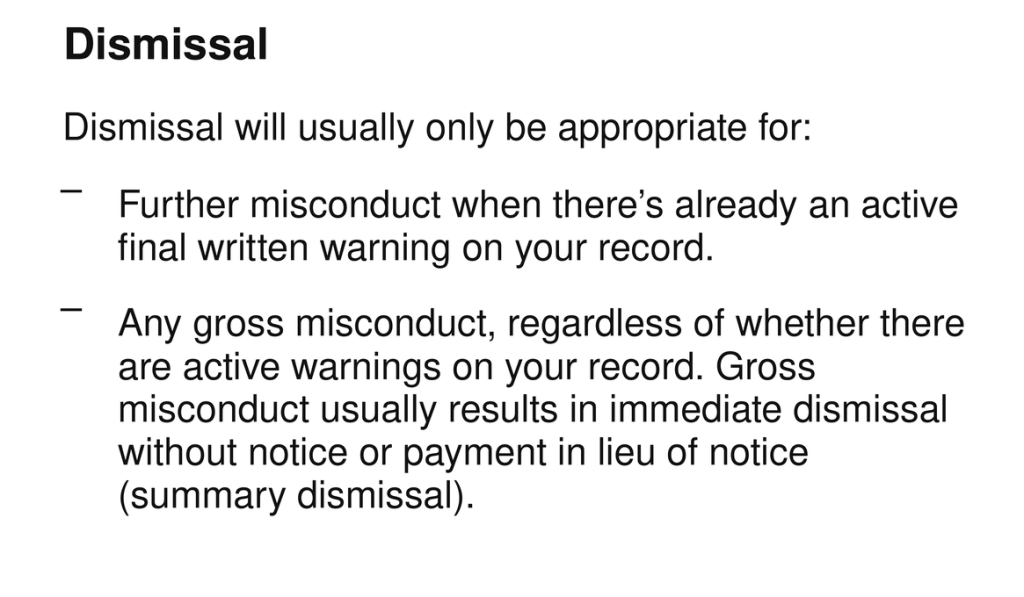
The minutes record the Head of Cabin Crew stating that, because the matter had been going on for so long, she would try to deal with it as quickly as possible. I received her outcome fifty-three days later, almost a year to the day after my flight with Felix.
After being informed that my appeal had not been upheld, I contacted Acas, the Advisory, Conciliation and Arbitration Service, about taking the matter to an employment tribunal.
Acas is an independent public body funded by the government. It provides free and impartial advice to employees and employers on workplace rights, employment law and resolving disputes. Anyone intending to bring an employment tribunal claim must first notify Acas, which can then offer early conciliation in an attempt to resolve the dispute without legal proceedings.
Acas also publishes the Code of Practice on disciplinary and grievance procedures, which sets the minimum standards of fairness employers should follow. These include investigating the facts, acting consistently, avoiding unreasonable delays and allowing employees to present their case and appeal decisions.
Although failing to follow the Code does not automatically create a legal claim, it cannot simply be ignored. Employment tribunals are required to consider it in relevant cases. If an employer has unreasonably failed to comply and the employee succeeds with their claim, any compensation awarded can be increased by up to 25%. An employee’s award can also be reduced by up to 25% if they unreasonably fail to follow the procedure.
This was the second time I had contacted them, the first being after my meeting with Hayley. During that conversation, I was advised there was nothing I could do until my appeal had been heard.
This time, I was advised that I should first exhaust the company’s internal procedures. That meant submitting separate grievances against each crew member whose statement I believed contained untrue information: Felix, Sybil, Trixie, Peter and Wayne. I was also advised to submit a further grievance about how the Head of Cabin Crew had handled my appeal.
On 9 February 2020, I submitted five separate grievances against Felix, Sybil, Wayne, Trixie and Peter. My manager warned me that it might be some time before I received a response because all seventeen Cabin Crew Managers were already handling at least two disciplinary matters. I was genuinely shocked that at least thirty-four disciplinary cases could be ongoing at any one time.
As the Covid crisis developed, I was told that further delays were likely because restrictions meant many office-based employees were away from the workplace. Yet only a few days later, on 30 March, an Employee Relations Consultant informed me that my grievances could not be accepted as written because they included issues that had already been investigated and dismissed during my appeal.
Those issues formed the substance of my grievances against the five crew members. Removing them would have left nothing to investigate. That response prompted me to submit a separate grievance concerning how the Head of Cabin Crew had handled my appeal and the case as a whole.
It was submitted at the end of May to a senior manager, who informed me that she was leaving the business the following week. She therefore forwarded it to her manager, Brian, a senior executive connected to HR.
I never received a response before my employment ended five months later, in October 2020.
In 2022, while still trying to clear my name, I contacted the airline again. A senior manager and legal counsel informed me that the company had been unable to deal with my grievance because of Covid. The matter had therefore been closed.
At the time, Acas had issued specific guidance on handling disciplinary and grievance procedures during the pandemic. It stated:
“Employers need to consider how to proceed in a fair and reasonable way. They should do this in consultation with those involved in the procedure.”
The decision to close my grievance directly contradicted that guidance. No one consulted me about how the matter could proceed, and I was never informed that it had been suspended or closed. The Acas Code also required employers to deal with grievances promptly and without unreasonable delay. My grievance had simply been abandoned.
Despite the company’s claim that my grievance could not be dealt with because of Covid, other grievance investigations still took place during the pandemic.
Having reported sick on 21 December 2019, after receiving the outcome of my appeal, I never returned to work before being made redundant. That was partly because of my mental health and partly because a long-term health condition meant that I had been advised to shield. I could not have returned even if I had wanted to.
During the early Covid restrictions, cabin crew of all ranks voiced concerns on the company’s internal communications platform about the close contact they were having with customers while delivering inflight services. The discussions became heated and, understandably, many crew members were deeply concerned. Although I do not know the specific details, I was led to believe that the company disapproved of some of those discussions.
As employees could not be called into the office for disciplinary meetings, the company introduced a new measure known as a “Letter of Concern”. It was issued to some crew members whom they considered to have spoken out of turn.
When redundancies were announced, employees who had received one of these letters were initially told that their jobs were at greater risk. Because so many crew members were affected, the union became involved, and that decision was later overturned.
A colleague, who had been with the company longer than I had and was also an Onboard Manager, received a Letter of Concern. A formal investigation followed, although I cannot recall whether it was conducted in person or by telephone. She described the experience as “utterly terrifying and traumatic” and said that she had been warned she could lose her job if the allegation was upheld.
Several months after being made redundant, the name of the former Head of Cabin Crew appeared while I was browsing LinkedIn. She had also left the company. Reading her profile was deeply unsettling and, at the time, seemed to make everything fall into place.
She described being responsible for improving employee engagement procedures to achieve business targets and implementing performance improvement plans intended to increase staff productivity. That explained Lana’s repeated recommendations for further training and development, which Hayley later repeated.
Having initially been absent for eighteen months, followed by three further periods of sickness due to the stress of dealing with Felix’s complaint, I suspected that my sickness record was the reason I was being pushed out.
Her profile also stated that, in the position she held before becoming Head of Cabin Crew, she had achieved a significant reduction in costs by “restricting employment tribunal claims”. I had no way of knowing whether that had any bearing on my case. However, I had made it clear from the start that I would pursue the matter for as long as necessary and, if required, take it to an employment tribunal. Her statement certainly made me think.
I had worked for the company for almost thirty years without a single black mark on my record, and my manager had repeatedly described me as a high-performing member of his team. Yet within the space of a few months, I received a final written warning and a written warning. The Head of Cabin Crew heard my appeal in the first case and requested that the second matter be handled as a formal grievance.
By the time I read her LinkedIn profile, I had already begun questioning whether the incident from 2014, which I had completely forgotten about until recently, had influenced the way my case was handled.
In my redundancy notification, I was informed that my performance as an Onboard Manager was below average. Performance scores were the primary metric used to decide which flying staff would be made redundant, while the two live sanctions on my file placed me at greater risk.
That assessment contradicted years of official performance feedback. When I examined the scores recorded during my final months with the company and the documentation used to calculate the score that placed me below average, it raised further concerns about the fairness and accuracy of the process.
As Head of Cabin Crew, it seemed reasonable to assume that she would have had some involvement in decisions affecting the size and structure of her department, although I had no evidence that she influenced individual selections. Given what had taken place over the previous eighteen months, the possibility that she had been involved in any part of the process raised further concerns in my mind.
Her reference to restricting employment tribunal claims was particularly unsettling. I had made it clear that I intended to pursue my case to a tribunal if necessary. Making me redundant could not legally prevent that, but the monumental change to my life would certainly make pursuing it more difficult, particularly as I had already been off work with mental health issues for more than four months before redundancies were announced.
This entire period is discussed in further detail in my book.
Life during my last twelve months in the company was not easy. The stress and anxiety I experienced are difficult to put into words. Returning to work in 2018 was a monumental achievement, but less than a year later, my mental health was worse than it had ever been.
Despite the constant battle to clear my name from Bart’s malicious lies, whenever I flew, I gave 100%. Neither my colleagues nor the customers I looked after could ever have imagined what I was going through.
This behaviour is not uncommon, especially for men, and it’s usually the reason why it comes as a shock when someone takes their own life. What makes this situation even more disgraceful is that the airline was fully aware of my struggles with mental health before, during and after the grievance raised by Bart.
In September 2019, a few weeks before my appeal was due to be heard by the Head of Cabin Crew, I checked in for a flight to a destination in North America. I didn’t operate this route very often and was looking forward to having breakfast in a beachfront café, followed by a wander around the shops. What happened that day I will never forget.
About three hours into the flight, shortly after the lunch service in Business Class had finished, I told the crew to have something to eat and went into the cabin to chat with customers, as I always did.
While speaking to a nice lady at the bar, I suddenly felt strange. It was a feeling I had never experienced before. I excused myself and went to find some chocolate because I was very hungry and thought that might be the reason. It made no difference, and I began feeling light-headed.
Upon reaching the forward galley, which on this aircraft was behind the cockpit, I asked a colleague for help.
Over the next four hours, the way I felt continually changed. One minute I felt okay, but the next I felt terrible. At times, I was breathless, sweating and experiencing mild chest pain. From my medical training, I thought I might be in the early stages of a mild heart attack, but I felt calm and was acutely aware of everything going on around me. My priority was preventing any disruption to the inflight service.
The Purser working in Economy came to the front to help and sought advice from the company’s medical team on the ground, which is standard procedure during certain medical incidents. As I was unfit to continue with my duties, he took over responsibility for the flight.
Although there were two Pursers on some flights, the company had recently removed the Business Class Purser on some aircraft, replacing them with a standard crew member. The Onboard Manager then took over all Business Class-related duties.
When the afternoon tea service began, two hours before landing, I could see that things were not running smoothly. The only place I could sit was in the galley, which was small and busy, with the crew in the middle of the service. As I was unable to help in the cabin, they were also under additional pressure.
I therefore asked the Purser to make a brief announcement apologising for any disruption to the service.
For landing, I sat in the back galley. Once we arrived, I left the aircraft before the Captain turned off the seatbelt signs, accompanied by a paramedic who had met the flight. While sitting on an ambulance bed at the top of the jetway, more than three hundred customers passed by. Thankfully, I was facing away from them.
I have never been so embarrassed. I also felt personally responsible for the disruption to the afternoon tea service in Business Class. I took enormous pride in the standard of service delivered on my flights. Shortly before landing, I would usually walk through the cabin and ask customers whether they had enjoyed the service and whether they had any feedback they wished to share.
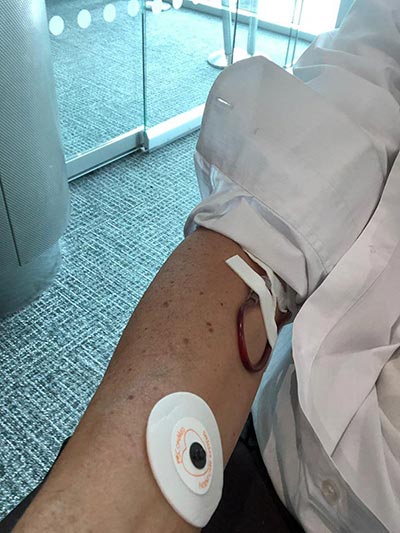
After being assessed, I spent several hours in the waiting area. It was incredibly hot outside, so the air conditioning was on full blast. I was exhausted, didn’t have the uniform sweater that I sometimes wore in the cabin and did not want to sit in my uniform jacket. There was no opportunity to collect my suitcase, so it was taken to the hotel by my crew.
I was freezing and very hungry.
The only place to buy food was in an adjoining building. Although there were vending machines nearby, they didn’t accept credit cards, and I had no cash on me. I didn’t want to leave the area in case I was called.
While waiting, I sent a message to the Purser on my crew.
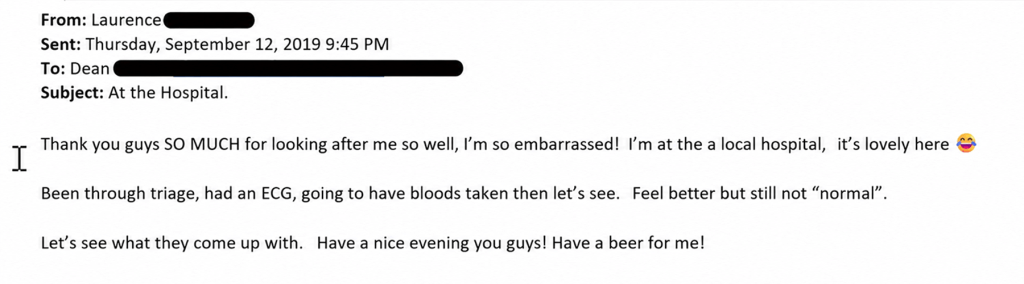
After seven hours and countless tests and scans, they were unable to find anything of concern. I was discharged, made my way to the crew hotel, and crawled into bed, completely exhausted. It was 1 a.m. local time and 6 a.m. in the UK. I had been awake for more than twenty-four hours.
The following morning, the company’s medical team advised me to travel home as a passenger, which is relatively standard after a medical episode such as the one I had experienced. Since the hospital had found nothing wrong and I felt well enough to fly, I insisted on working. There was no way I was going to let my team or the company down for a second time. I could have slept in a Business Class seat during the eight-hour flight home, but instead chose to work.
In hindsight, and after speaking with my GP, I believe that I experienced an unusual panic attack. What triggered it, I have no idea, but I am certain that it was connected to the enormous amount of stress I had been dealing with over the previous nine months.
I am confident that the Head of Cabin Crew would have become aware of the incident. It was extremely rare for an Onboard Manager to become unwell during a flight and leave the aircraft by ambulance. My manager called me a few days later to check that I was okay.
News travels quickly in this industry. In fact, we had our own name for the grapevine or rumour mill: Galley FM.
On the night flight home, I spent time speaking with one of the crew working in Business Class. I had noticed her performance on the outbound flight before becoming unwell. Despite my significant embarrassment and being in the way, and having to share personal medical information I would rather not have shared, she had been incredibly kind.
The standard to which she completed her duties stood out again on our return flight. When I spoke with some customers before landing to ask if they had enjoyed the flight, several mentioned her to me.
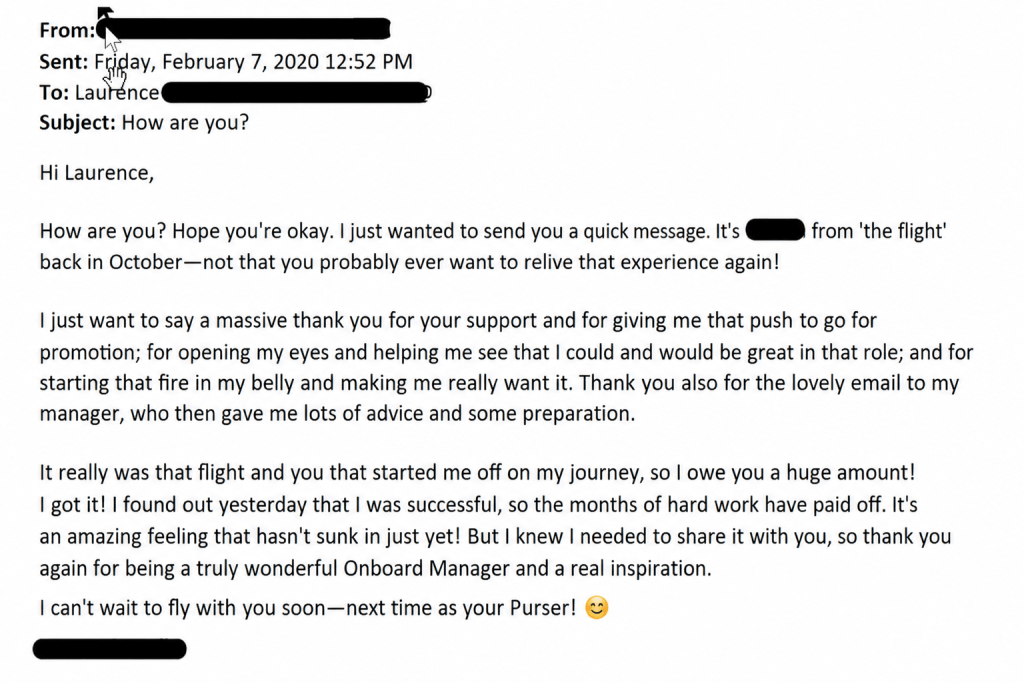
Although I completed written feedback on her during the flight, once home, I also wrote to her manager; something I had done for many crew members over the years. A few months later, in February, I received an email that brought a much-needed smile to my face. She had applied for promotion to Purser and had been successful.
Sadly, the outbreak of COVID a few months later meant that she never got to do her training course and was instead made redundant.
This crew member and many others like her were part of the reason I stayed with the airline for thirty years. What a contrast to the five crew members I had the misfortune of flying with on 24 December 2018.
If I had become unwell during the flight with Felix, there would have been no other trained Onboard Manager available to take over my responsibilities. Another crew member would therefore have had to step into the role, meaning that all three onboard management positions would have been filled by people who were not trained.
That does not mean the safety of the flight would have been compromised. All cabin crew received the same safety and medical training, and the Captain remained in overall command. However, there’s an Onboard Manager on each flight for a reason. They’re the most experienced crew member, will have years of onboard management experience, and have been trained to company standards.
The role of an onboard manager involves leading the entire crew, making operational decisions, managing or co-ordinating serious medical or customer-related incidents and acting as the main link between the cabin crew and flight crew.
In this airline, Pursers and Onboard Managers were given adequate training to ensure they could carry out their duties to a high standard. However, when an onboard manager was missing from a flight, they were quite happy to allow a crew member to step into that role.
What happened on my flight with Felix is a perfect example of why that should never happen. Part of a Purser’s responsibility is to support the Onboard Manager and cover for them during rest breaks, or in the event they become unwell. With my flight not having any trained Purser, and with two crew members working in to fill those positions, I had very little support.
Had there been at least one trained Purser on the flight, I would have received a great deal more support while fighting Felix’s grievance than I did.
Arthur, the Purser who worked in Economy, was good friends with Sybil, who I discovered while compiling my defence, was Felix’s fiancée. Arthur and Sybil were also good friends with Trixie, and Trixie and Peter were best friends. All of these crew members worked together in Economy, from the galley at the back of the aircraft.
Although Katrina, who worked up as Purser at the front, did an excellent job and was supportive of me in her statement, she wasn’t a trained Purser. Therefore, I didn’t discuss Felix’s performance during the flight with her, so her knowledge of the situation that I decided to deal with through post-flight feedback was far more limited.

