| Table of Contents Page 1 – Introduction Page 1 – Being Cabin Crew Page 2 – Behind the Galley Curtain Page 2 – Employee Mental Health Page 3 – Working Well, Living Better Page 4 – Ex-Police Officer Bart Being Cabin Crew | The Ugly Truth Part 2 |
Behind the Galley Curtain
Throughout my career, there were occasions when flights went ‘crew down’. This meant operating with fewer cabin crew than there should be. A flight could still depart provided it carried the legal minimum number of cabin crew for safety, but fewer crew meant greater pressure on everyone working onboard. The legal minimum for each aircraft type was set by the UK Civil Aviation Authority.
Going ‘crew down’ was quite common, especially over Christmas and other bank holidays due to high sickness levels. I remember one year, shortly after becoming an Onboard Manager, when many cabin crew called in sick on the day of the Big Brother final.
To cover unexpected absences, cabin crew were rostered for standby duties. Depending on the type of standby, you could be informed several hours in advance that you had been allocated a flight, or have just two hours to reach the airport after receiving a call. Those who lived too far away sometimes did their standby at the airport or drove somewhere closer, often spending hours in a service station waiting for their phone to ring.
The Crewing department was responsible for calling crew members. Whenever possible, flights were allocated well in advance, but last-minute calls were sometimes unavoidable.
While I was on my last period of long-term sick leave, before being made redundant, I noticed from my company-issued iPad that flights were still showing on my monthly roster, even though they shouldn’t have been. A former colleague later told me that, on one occasion, I was showing as the Onboard Manager on a flight he was operating, but having failed to arrive at Cabin Crew Check-In, a replacement was called.
Cabin crew normally check in two hours before a flight departs. By the time it became apparent that I was not there, whoever was called to replace me had very little time to reach the airport. For anyone driving, reaching the staff car park was only the beginning. Parking, taking the staff bus, passing through security and travelling to the aircraft could take another forty minutes or more.
The replacement did not arrive in time, so the Purser worked up a rank as Onboard Manager and another crew member worked up as Purser. The flight therefore departed one crew member down.
For many years, if you failed to arrive at Cabin Crew Check-In within the time allowed after being called from standby, you were given a ‘late form’. There was nothing more disheartening than rushing like a lunatic to the airport, stressed that you wouldn’t make it, only to arrive and be presented with a late form. Was that really necessary?
I believe the late form was introduced to discourage crew who didn’t want to operate a particular flight from deliberately taking their time after receiving a late call. If they missed the flight, they would either go home or wait at the airport in case they were needed for another flight.
As long as you reached the aircraft before the door closed, did it really matter that you arrived slightly later than you should have.
Cabin crew working up in a rank they were not trained in was also quite common. This was necessary when a Purser or Onboard Manager position was missing from a flight, and there was no one left in that rank to call on standby. The most likely reason for that was because all crew in that rank on standby had already been used for other flights.
Cabin crew who were not part of the onboard management team could work up one rank, to Purser. Pursers could work up as an Onboard Manager or down as cabin crew, while Onboard Managers could work down as Purser or cabin crew.
Many years ago, I operated a Christmas Eve flight to a Caribbean destination on a Boeing 747 with four crew members down. There were twelve of us, including one crew member working up as Purser, responsible for more than 400 passengers. The flight operated at ‘minimum crew’, meaning we had the minimum number of cabin crew legally permitted for that aircraft.
A few days before my Christmas flight with Felix on 24 December 2018, I checked my iPad and noticed that the crew complement was incorrect. There should have been nine cabin crew, two Pursers and one Onboard Manager, but instead, there were ten cabin crew plus me. Not only were we one crew member down, but more importantly, there were no Pursers, meaning I was the only onboard manager.
I expected Crewing to notice the problem and make the necessary adjustments. When nothing had changed by the day before the flight, I called to bring it to their attention. I explained that a friend of mine, who was also an Onboard Manager, was on standby and asked whether he could join my flight and work down to fill one of the Purser positions. I was told that he was needed for another flight, but that they would look at adjusting my crew shortly.
Before leaving home for the airport, I checked my iPad again. Nothing had changed. When I arrived at Cabin Crew Check-In, I was told that everyone on standby had been used, so I would probably be going one crew member down and without any Pursers.
The Pursers formed part of the onboard management team. One worked in Economy and the other in Business Class. They ran the services and led, supported and developed their crew. They also supported the Onboard Manager and covered for them during rest breaks or if they became unwell and were unable to continue with their duties.
The other issue with this flight was the level of experience. Of the ten cabin crew members, seven were either still within their twelve-month probationary period or had only recently completed it. Another crew member was operating his first flight after spending a year on a ground placement.
On flights that were missing a trained Purser, someone would have to work up to cover the position. If Crewing identified the problem in advance, someone called from standby might be told that they would be required to work up. Alternatively, the Onboard Manager may only realise that it was necessary when allocating cabin crew onboard working positions at cabin crew check-in.
The final decision about who was most suitable rested with the Onboard Manager. They would usually ask the most experienced crew member, based on their length of service or time in rank.
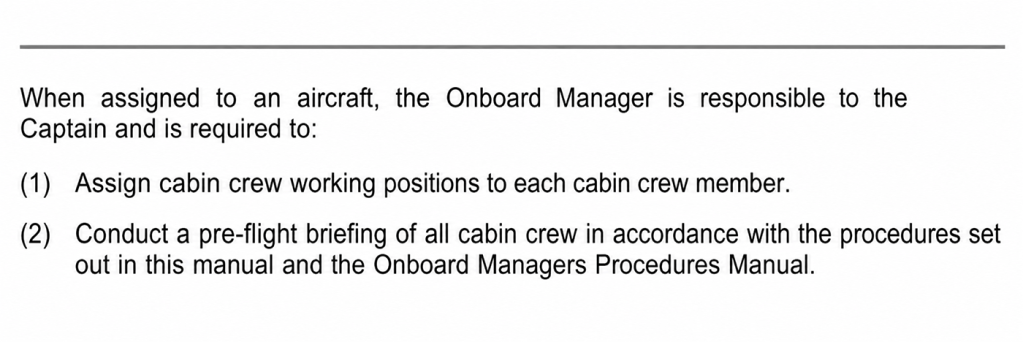
Since joining the airline in 1990, it had always been a requirement that cabin crew working positions, officially known as ‘areas of responsibility’, be allocated by the Onboard Manager. However, most, including myself, allowed the crew to choose where they wanted to work, which was far more popular and widely accepted.
The following extract comes from the company’s Cabin Crew Procedures manual;
From the day the airline began operations, cabin crew there were Junior Cabin Crew and Senior Cabin Crew. Juniors worked in Economy, while Seniors worked in Business Class.
In 1992, the airline introduced Mid Class, renamed Premium Economy in 2008. The cabin offered larger seats with more legroom, with extras such as a welcome drink after boarding and newspapers. Most other aspects of the service were the same as Economy.
For many years, two dedicated crew members worked in the cabin: one Junior and one Senior. In 2015, the Senior position was removed, leaving one Junior as the only dedicated crew member.
The Economy crew were then responsible for delivering the main service in both cabins, adding another six to eight rows to an already considerable workload. The dedicated crew member was responsible for the additional elements specific to Premium Economy.
In March 2018, Premium Economy was rebranded as Premium.
For several years, rumours had circulated about the Junior and Senior ranks being combined, enabling any cabin crew member to work in any of the three cabins. The company always denied that this was being considered.
However, in 2018, it announced that the two ranks were being combined. The announcement received a mixed response. The main issue was that promotion to Senior had always come with an increase in salary, but when the company brought the two rates of pay into line, the Juniors received a minimal pay increase, while the Seniors had to take a pay cut. Senior Cabin Crew who didn’t want to accept the new contract were offered redundancy.
I was one of only a small number of cabin crew who supported the change. My reason was that we had many great Junior Cabin Crew who always worked in Economy, which was the busiest and most demanding cabin. Meanwhile, the Seniors worked exclusively in Business Class, which was a far nicer and more relaxed environment. Between services, the Business Class crew had time to relax, read a newspaper or sit and have a coffee. In Economy, especially on day flights, the work was non-stop.
I therefore saw no reason why any capable cabin crew member shouldn’t be able to work in any cabin. The additional skills required for Business Class could be learned through training and experience.
However, there were problems with how the change was implemented. With Business Class being the cabin of choice, some crew began arriving at Cabin Crew Check-In far earlier than necessary to secure their preferred working position. Positions could only be chosen once a Purser or Onboard Manager had arrived. When I made my way to a briefing room to prepare for the pre-flight briefing, it was common for several crew members to follow me, all eager to put their names against a position.
The small number of Onboard Managers who followed company procedure and allocated the positions themselves often did so in order of seniority. Therefore, the most senior crew members still tended to work in Business Class.
Although that may seem logical because of their experience, it created another problem. Less senior crew members, or those who arrived after all the Business Class positions had gone, were not gaining the experience they needed to work in that cabin.
Working at the front was very different from working in Economy, and the Business Class galley position required a certain level of expertise. The galley, where food is prepared and plated, is the heart of the service. For the Business Class service to run smoothly, the galley had to be well organised and run efficiently.
Imagine working as waiting staff in a busy restaurant when the only person in the kitchen has little or no experience. Understandably, it would be likely to have a significant impact on the customer experience.
In the months after the Junior and Senior ranks were combined, I operated several flights where none of the crew had ever worked in Business Class. Working with an entire team unfamiliar with the service and environment, including someone operating in the galley for the first time, made everything far more difficult and affected the pace and standard of the service.
Following one particularly awful flight, I decided that from then on, I would allocate the working positions myself instead of allowing the crew to choose where they wanted to work. I felt this would ensure that everyone had the opportunity to gain experience in all three cabins. It would also give those who always chose to work at the front an opportunity to share their experience with less experienced crew in Economy.
The other issue with combining the two ranks was that what had once been a four-day Senior Cabin Crew training course had, in recent years, been reduced to two days. The course had now been abolished completely, and crew members were simply required to read the Business Class Cabin Training Brief. While some cabin crew did, many didn’t.
The company stated that for the first six months, new cabin crew should only work in Premium or Economy.
With so many inexperienced crew members, deciding who should work up in the two Purser positions was extremely difficult. Only Lottie, Bruce and Arthur had been with the company for any length of time. I had worked with Bruce many times but didn’t feel he was suitable for a supervisory role. I therefore allocated him the Business Class galley position.
Although Arthur had seven years’ service, he was operating his first flight after spending a year on a ground placement. A few days earlier, he had emailed me asking that I allocate him an aisle position in Economy or Business Class so that he could get his bearings.
After I arrived at Cabin Crew Check-In, a Cabin Crew Manager told me that Arthur had recently applied for promotion to Purser but had not been successful. Given my limited options, I decided to ask whether he would like to work up as one of the Pursers, as I felt it would be invaluable experience.
When I spoke with him, he was enthusiastic and happy to step into the role.
I had intended to ask Lottie, who was the most experienced crew member, to work up as the other Purser. However, the Cabin Crew Manager also told me that Katrina, despite having only recently joined the company, had spent thirty years as cabin crew with her previous airline, including twenty as an Onboard Manager.
With Katrina having many years of experience as an Onboard Manager, albeit with another airline, I decided to ask if she would like to work up as Purser in Business Class. This meant that Lottie could work an aisle position. Had Lottie worked as the Business Class Purser, three relatively new crew members would have been serving the customers in that cabin. I knew from past experience that could affect the pace and even the standard of the service.
The company had put me in an impossible situation, and every decision I made was carefully thought through. At this point, we were still one crew member down.
It was only as we were leaving Cabin Crew Check-In for the aircraft that I was told someone had been called from standby and would be joining the flight. This brought the total to eleven cabin crew, including two working up as Pursers.
My decision to give Arthur this opportunity was partly influenced by my own experience. The first time I applied for promotion to Onboard Manager, I was unsuccessful. On the day I received my rejection letter, I was told that I would be required to work up in that rank on my next flight.
Having just been turned down for the position I was now being asked to fill, I was very reluctant. After speaking with my manager, she explained that it would be valuable experience and would look good on my file. I learned from that and applied the same approach many times throughout my career.
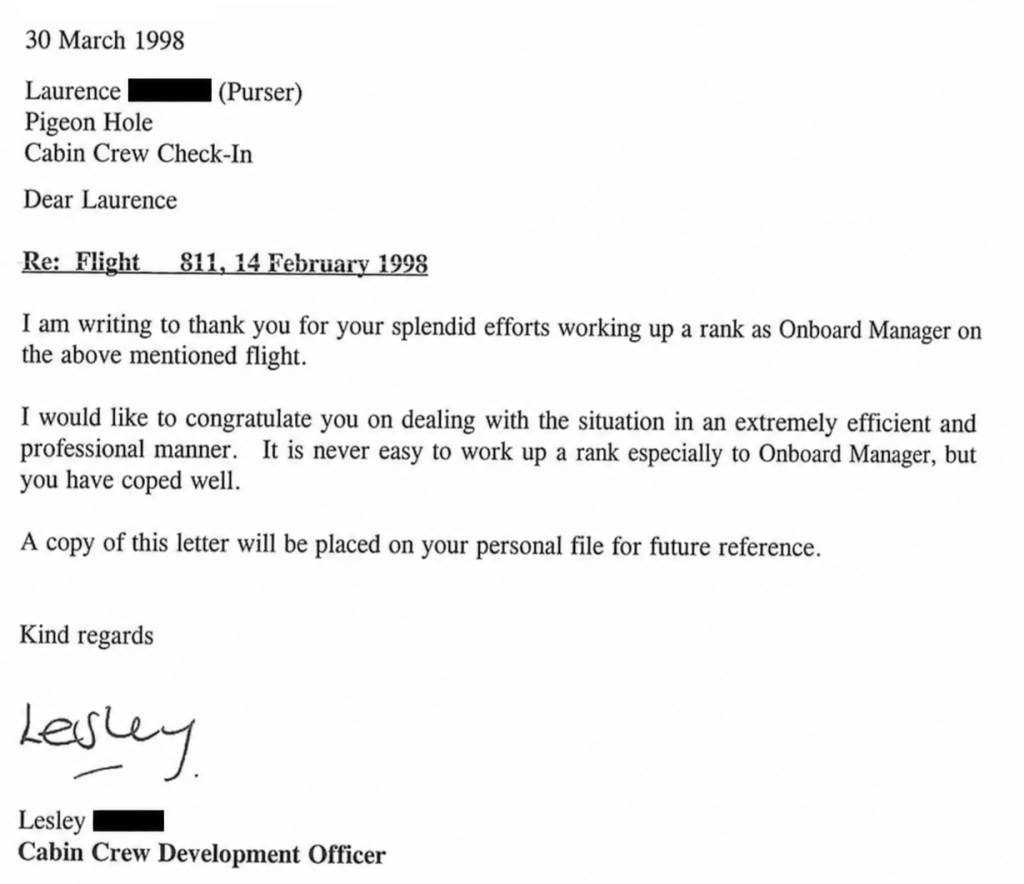
That flight was my second time working up as an Onboard Manager, and I had to deal with a particularly challenging situation. After returning home, I received the following letter from my manager.
On another occasion, shortly after being promoted to Onboard Manager, I checked in for a flight to a destination with a reputation for being extremely busy. I discovered that we were three crew members down: two Juniors and a Purser.
After speaking with the trained Purser who was present, I asked an experienced Junior with whom I had flown many times whether she would like to work up as the Purser in Economy. In those days, asking a Junior to work up, instead of a Senior, was unheard of. However, with Seniors rarely working in Economy, I felt that asking someone with extensive experience working in that cabin would be a good idea. The alternative would have been for the trained Purser to work in Economy, which they were very used to doing, and for a Senior to work up as Purser in Business Class.
Believing that Sheryl was more than capable of stepping into the role, I wanted to give her this rare opportunity. She did a great job, and many years later, she became a Cabin Crew Manager.
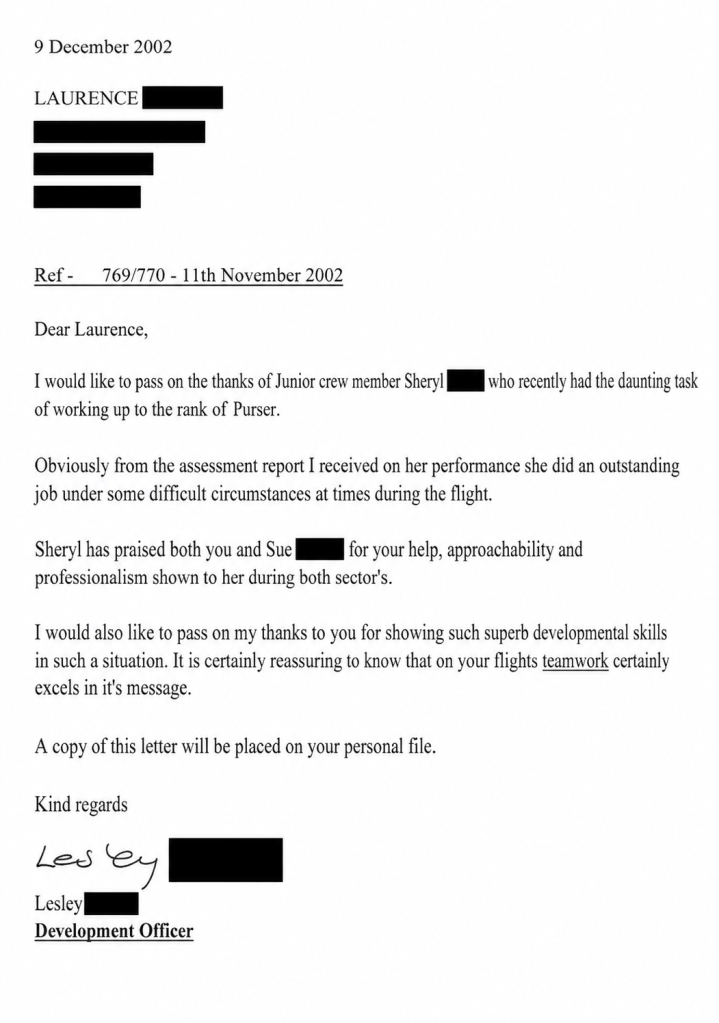
I wrote detailed performance feedback about her during the flight, and subsequently received the following letter from my manager.
F/A means Flight Attendant, the title now known as Cabin Crew. Sue was the trained Purser who worked in Business Class.
Although a cabin crew member having to work up as Purser was not a particularly unusual situation, in all my years of flying, I had never heard of a flight that had gone with only one Onboard Manager and two cabin crew working up as the Pursers. I’m not even sure it had ever happened.
You may recall that I mentioned I had flown with Bruce many times, but didn’t feel he was suitable to work up as Purser. He had been with the company for about four years. Having asked if he had worked the Business Class galley before, which is the position I allocated him, he confirmed that he had.
As the galley crew member, Bruce was responsible for ensuring all services were ready to start on time, and for heating, plating and presenting the food. On our return flight, which was full and exceptionally busy, Trixie approached me at the Business Class bar during the dinner service with two meals she was about to serve. She wanted to draw my attention to the size of the turkey slices on the Christmas dinner, which, she said, were so small. When I saw how the meals had been presented, I couldn’t believe my eyes.
The Business Class meals are loaded in foil trays, with each component in a separate container. Once heated, it’s the galley crew member’s responsibility to present the food on the plate. The meals are then collected by the cabin crew working in the aisles and delivered to customers in their sections.
The company provided a guide containing large photographs showing exactly how each course should be presented. Even without looking at the guide, who on earth would present food being served as part of a ‘restaurant-style experience’ in this way? In all my years as cabin crew, I had never seen anything like it.
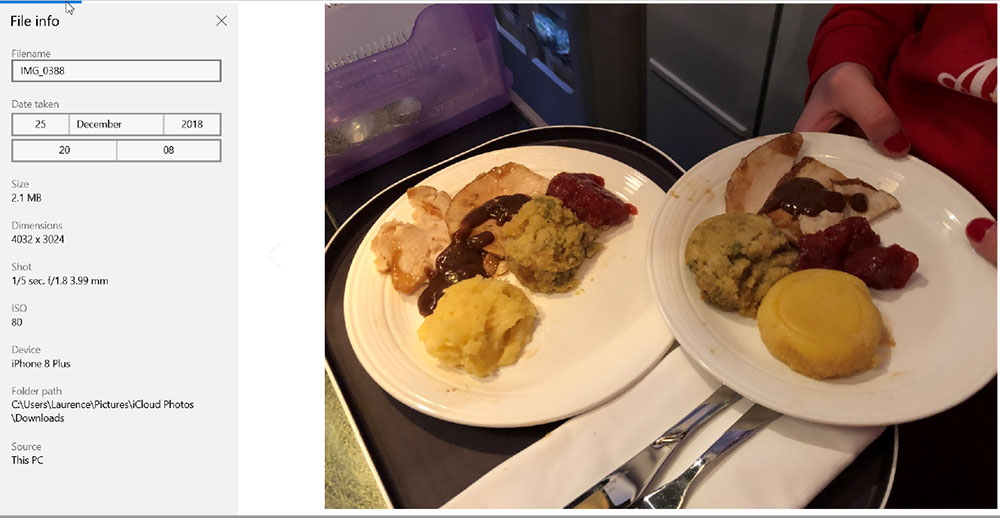
I took the photo to send with my flight documentation to the catering department to address the issue of the size of the turkey slices. I then went into the galley to speak with Bruce about how he was presenting the food.
When I walked into the galley, it was chaos. Bruce told me one meal couldn’t be used because it had been overcooked. Another was waiting to be picked up by a crew member to be delivered to a customer.


Four weeks after returning from the flight, I was informed that Felix had raised a grievance against me. What followed was a lengthy process involving two separate stages of investigation.
I found the initial grievance meeting incredibly stressful because I was still grieving for my dad and had only returned to work ten months earlier after a long absence. In the days that followed, my depression worsened, so I wasn’t able to fly. I reported sick and was off for five weeks.
During that period, I worked relentlessly on preparing my defence for the second stage. When several of the most serious allegations were upheld in the outcome, I submitted an appeal. It challenged how the entire case had been investigated and raised serious concerns about the way both Cabin Crew Managers had conducted their investigations, particularly the lack of impartiality and apparent bias. I also presented persuasive evidence showing that Felix’s allegations and several witness statements contained claims that were inconsistent with, and in some cases directly contradicted by, documentary evidence.
By the conclusion of the second stage of the investigation into Felix’s complaint, his allegations of inappropriate touching, together with one other, were being treated as potential gross misconduct. This placed me at serious risk of losing my job. Under the company’s disciplinary policy, a finding of gross misconduct could result in immediate dismissal.
Just one week before my appeal meeting with the Head of Cabin Crew, a separate matter arose. A “concern” had been raised with her regarding a post I had made in a private chat group on the company’s secure internal communications platform.
Four days after submitting the post, I received a private message from one of the company’s most senior executives. We exchanged a few messages, and I believed the matter was over. Seventeen days later, just twenty-four hours before I was due to check in for a high-profile flight on which he was also travelling, I learned that it had been reported to the Head of Cabin Crew.
Instead of allowing my manager to deal with it informally, which would have been the correct course of action under the relevant company policy, the Head of Cabin Crew asked for it to be treated as a formal grievance. This created a potential conflict of interest because the following week, she would be deciding whether the first grievance had been handled fairly. More importantly, she had not yet seen the messages exchanged between us, yet had already decided how the “concern” should be handled.
As Head of Cabin Crew, she would have understood that if the second issue led to a further disciplinary sanction, it would strengthen the grounds for dismissal under the company’s disciplinary procedure.
This is where things get interesting. In 2014, I wrote to her to ask for her help. Unknown to me at the time, she had only recently moved into her position. My correspondence contained deeply personal information about my mental health and another intensely private matter. It was marked Private and Confidential. The nature of its contents should have made it obvious that it was not to be shared.
For reasons that were not explained, she informed me that she was unable to deal with it, so she had passed it to someone else. They then informed me that they too were unable to deal with it, so they passed it back to her. My correspondence was then passed to another manager in her team, who also couldn’t deal with it, so he passed it on to someone else. In total, it was shared with six different managers, all of whom I knew quite well as they were once cabin crew, and we had flown together several times.
Deeply upset and angry that correspondence containing legally protected sensitive personal data had been circulated in this way, I complained to a more senior manager, who dealt with the underlying matter immediately.
Five years later, when I told my manager that I wanted to appeal against how the two investigations into Felix’s complaint had been handled, I was advised that my appeal had to be sent to the Head of Cabin Crew. With everything I had been through in the intervening years, the incident from 2014 had slipped my mind.
Both stages of the investigation into Felix’s complaint were handled by Cabin Crew Managers. Cabin Crew Managers report to the head of the department: the Head of Cabin Crew.
Supporting Employee Mental Health
Christmas 2019 was really tough. It had been twelve months since my flight with Felix, and what followed was still dominating my life. The first anniversary of my dad’s death was also approaching. Although he was ninety-six when he died, which is a great age, the previous nine years had not been easy.
After my mum died very suddenly in 2010, my dad moved in with me, and my life changed overnight. He was my only family. Although I knew it was never going to be easy, I had taken on far more than I was able to cope with. As my mental health deteriorated, the pressure eventually led to what I can only describe as a nervous breakdown.
I kept what I was going through from my dad and tried to continue as normal, which made coping even more difficult. In 2016, following a serious fall, his health began to deteriorate. Two years later, although he enjoyed living with me, he was struggling with the stairs and needed help with some aspects of personal care.
We discussed the possibility of him moving into residential care, but he didn’t like the idea. However, the options for keeping him safely at home were limited, and he understood that residential care was the only way I would be able to return to work. It was an incredibly difficult decision, and I still carry considerable guilt for not finding a way to keep him at home.
Once my dad had settled into his new home, which was not far from where I lived, I returned to work. I could not have felt happier to be back doing the job I loved.
I had changed enormously over the previous eight years, and the confident, outgoing person I had always been no longer existed. I was quieter, more subdued and increasingly introspective. I felt more comfortable sitting on the outside looking in than being at the centre of the scrum. I spent far more time alone and chose my company carefully, preferring to be with one or two colleagues rather than a large group.
Lively gatherings no longer appealed to me, and in a strange way, being surrounded by laughter and happiness could make me feel extremely sad. Perhaps those moments released grief or vulnerability that I had kept buried, or reminded me of the person I once was.
This may make it sound as though I was always depressed and miserable, but nothing could have been further from the truth. I loved being at work, and it brought me genuine happiness. Whenever I was on an aircraft, whatever else was happening in my life, I felt safe and protected. It really was my comfort zone.
Although I couldn’t wait to get off the aircraft after some flights, once I was home and rested, I was already looking forward to my next duty.
Anyone who knew me would have described me as smiley, friendly and approachable. Those same words had appeared countless times in feedback throughout my career.
Over the next ten months, I slowly rebuilt my confidence. The previous nine years had taken their toll, but finally, there was a light at the end of the tunnel.
When I wasn’t flying, I visited my dad every day and spent several hours with him. He had no other visitors. Every Saturday morning, I would bring him back to the house to watch sport, which was his true passion. Weather permitting, we would also go for days out. One such trip was to Brighton, where my parents had spent the first few days of their honeymoon. I knew it would be the last time my dad would ever see it.
On 9 January 2019, he died peacefully in his sleep. Less than three weeks later, I learned of Felix’s complaint.
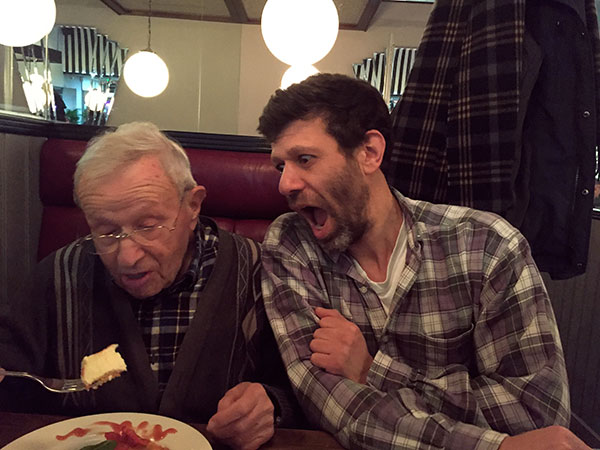
Fighting to clear my name decimated my mental health and led to three lengthy periods off work. I also experienced a particularly unpleasant stress-related incident on a flight to Miami.
I called in sick for the last time on 21 December 2019, after receiving the outcome of my appeal from the Head of Cabin Crew. She had upheld the remaining allegations against me, including the most serious.
On 13 January 2020, just after the first anniversary of my dad’s death, I spoke with my manager during what was supposed to be a welfare call. During our conversation, he asked when I would be able to deal with the second grievance investigation. Although I had attended a meeting for the first stage in October, with everything else I was dealing with, I had completely forgotten about it.
I remember vividly how I felt in the days following that conversation.
Given everything I had already been through, you would have thought some compassion would have been shown in the way this second matter was handled, but there were clearly other issues at play.
I told him that it really wasn’t the right time, but that I would let him know when I was ready.
Towards the end of January, I informed him that I felt able to proceed. He advised me that because I was on long-term sick leave, I would first need to be cleared by Occupational Health.
Following two long and difficult conversations with them, during which I had to share deeply personal information about my health and my life, they agreed that the only way I could move forward was for this matter to be resolved.
At my request, the formal disciplinary meeting that followed took place over the phone. What had started as a single concern about my post had developed into two separate allegations: one concerning the post itself and another questioning whether I had been honest about deleting it.
The matter concerned a tongue-in-cheek comment at the end of an otherwise constructive post. Its wording and the emojis I used made it clear that it was intended as humour, but a senior executive who read it took offence. Once he contacted me, I explained the context and offered a sincere apology.
The post was submitted in a private group that could only be accessed by invitation. Most members were experienced onboard managers, while four office-based managers from the Service Delivery department had also joined. Most of us had known each other for many years. I was unaware that the senior executive, Archer, had joined. In total, the group had forty-six members.
Brenda did not uphold the allegation that I had been dishonest about deleting the post, but upheld the allegation concerning the post itself. Her outcome then revealed something I had not previously been told: both allegations had been treated as potential gross misconduct and could have resulted in my dismissal without notice.
Gross misconduct had not been mentioned during my meeting with Fred, who conducted the first stage of the investigation, or in his final investigation report. The guidance supporting the Social Media Policy described responses ranging from an informal conversation with a Cabin Crew Manager and no further action to a final written warning. Although the wider disciplinary procedure allowed breaches of the Social Media Policy to be treated as gross misconduct, neither Fred nor Brenda explained when that classification had been introduced, who made the decision to introduce it, or why my comment was considered serious enough to cross that threshold.
Brenda ultimately decided that summary dismissal was not appropriate and issued me with a twelve-month written warning.
How a careless comment that was said in good faith, which I had apologised for and had been deleted, moved from something that could have been dealt with informally to something capable of ending my career without notice is one of many serious and troubling concerns that are discussed in detail in my book.
On 4 March 2020, I received a call about a flight that was still showing on my roster for the following day. I explained that I had been on long-term sick leave since 21 December. Three weeks later, the company appeared to be none the wiser.
On 27 March, in reply to an email I had received advising me that an appointment had been arranged for me to renew an ID. I said:
“Hi Sarah,
I am currently off on long-term sick leave and have been since 21 December. My manager and Occupational Health are both aware.”
Her reply:
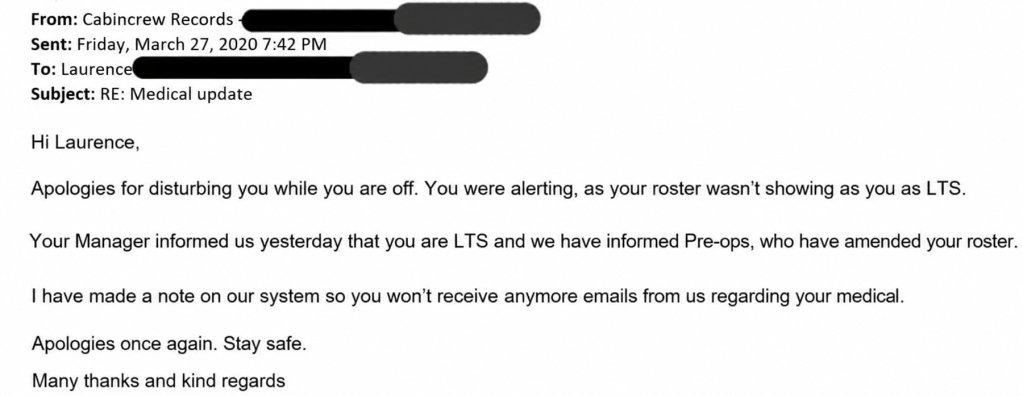
Her “stay safe” comment was because the first lockdown had come into force the previous day.
On 8 April 2020, I received a call from someone I didn’t know and had never spoken to before. He asked whether I would be operating my flight to Tel Aviv the following day. Struggling to comprehend what I’d just been asked, I told him I was on long-term sick leave and had been since 21 December. After a long pause, he said yes, I can see that, but I thought you may be returning to work because we don’t have a sick note from you.
That’s not how things work and never has. When a crew member is on long-term sick leave, no flying duties are assigned to their roster until they call in fit. No manager would ever call a crew member on sick leave to ask if they were operating their flight the following day. People can be off work for any number of reasons, so apart from that not being company procedure, it would not be something that’s acceptable to do.
With far more important things to worry about, I had forgotten to obtain a sick note, but said I would obtain one immediately and forward it to him.
Three weeks later, I received this email. I called in sick on 21 December, the day after I received the outcome of my appeal from the Head of Cabin Crew.
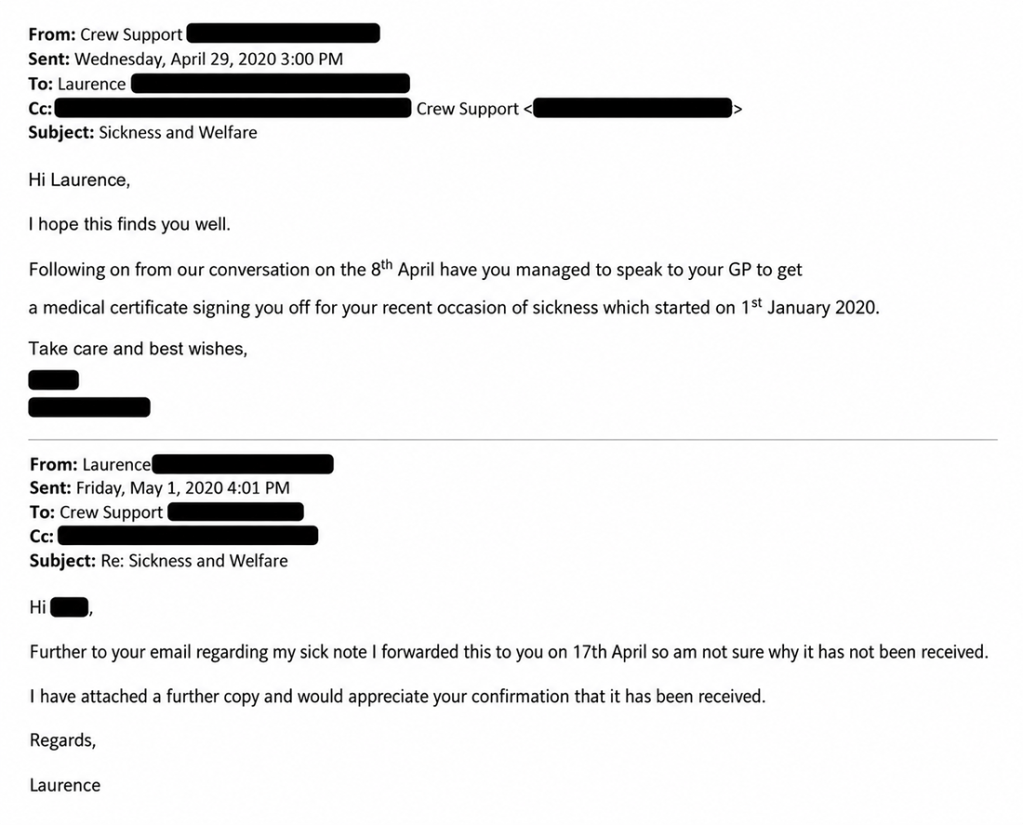
No confirmation was ever received, and I didn’t hear anything further from this person, or anyone else in the company until 2 July 2020. In that email, I was invited to a meeting to appeal the decision to make me redundant.
Having already participated in four stressful meetings relating to two unnecessary disciplinary matters, I had no fight left in me. At the time, I was also dealing with a cancer scare involving suspected throat cancer, which I mentioned in my response. Therefore, even if I had wanted to appeal the decision, I was in no state of mind to do so.
As much as I loved my job and didn’t want to lose it, I didn’t believe there was any chance of the decision being overturned.

