| Table of Contents Page 1 – Introduction Page 1 – Being Cabin Crew Page 2 – Behind the Galley Curtain Page 2 – What a Great Company Page 2 – Employee Mental Health Page 3 – Working Well, Living Better Page 4 – Ex-Police Officer Bart Being Cabin Crew | The Ugly Truth Part 2 |
Working Well, Living Better
On the subject of employee mental health, the following article was published in the company’s public blog:
Working well, living better
For people to thrive they need to be well and feel at their best. We take a holistic view of wellbeing and have invested in the physical, mental and financial wellbeing of our people. Our goal is a highly motivated, resilient and vibrant workplace where our people feel valued, listened to and supported. In 2018, a significant area of focus was mental health. We signed the Time to Change pledge and opened up the public conversation about mental health to reduce stigma and discrimination within the workplace. We launched mental health first aid training and awareness sessions across the business and tailored peer to peer support for crew members.
In 2018, we launched an awareness course which saw 1,600 of our people leaders develop the mindset and techniques they need to be at their best in order to lead and inspire their teams. We believe that by enhancing the capacity and capability of our leaders we can enhance the experience of all our people, ultimately leading to stronger engagement. All these initiatives contribute to the long term happiness of our people and therefore to the long term health of our business.
I attended this two-day mental health course but couldn’t bring myself to attend for the second day. From the perspective of someone who struggles with mental health, it could not have been worse.
Towards the end of the day, a colleague sitting next to me, who I didn’t know that well, said, “You’re not coming back tomorrow, are you?” We hadn’t really spoken the entire day, but they had noticed something was wrong.
I subsequently sent this email to the manager who organised the course. I had known him for as long as I’d been in the company and had a good relationship with him like I did with most colleagues.
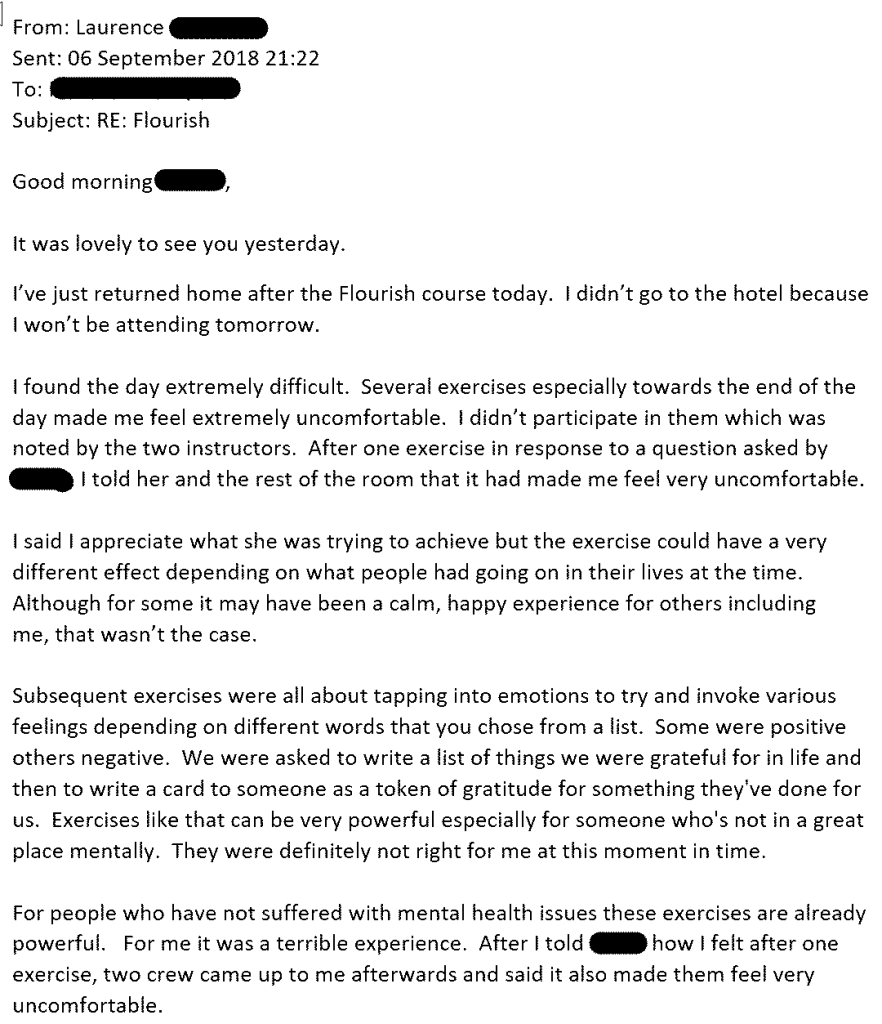
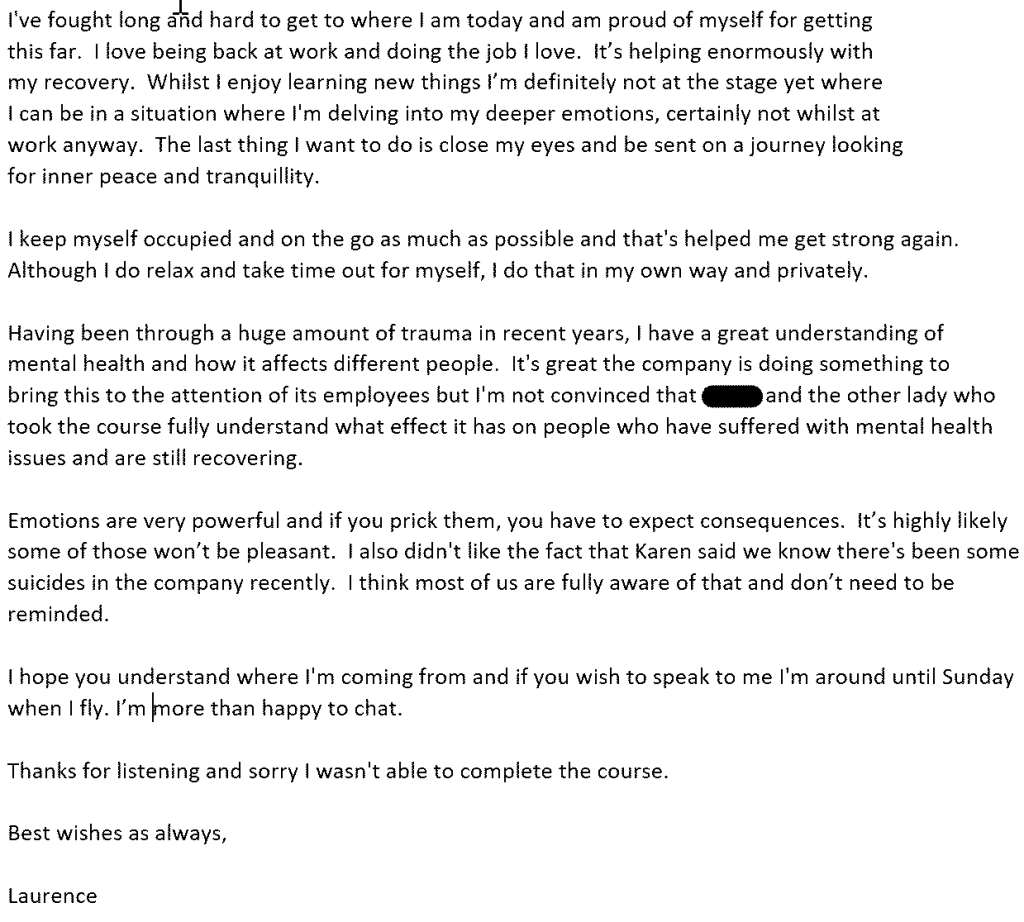
Several articles published online by the company discuss the importance of mental health in the workplace and their efforts to ensure that all employees feel well-supported. One article in particular was referenced in a tweet posted by someone closely related to the owner of the airline. I talk more about that in due course.
Here’s another article published on LinkedIn that caught my eye:
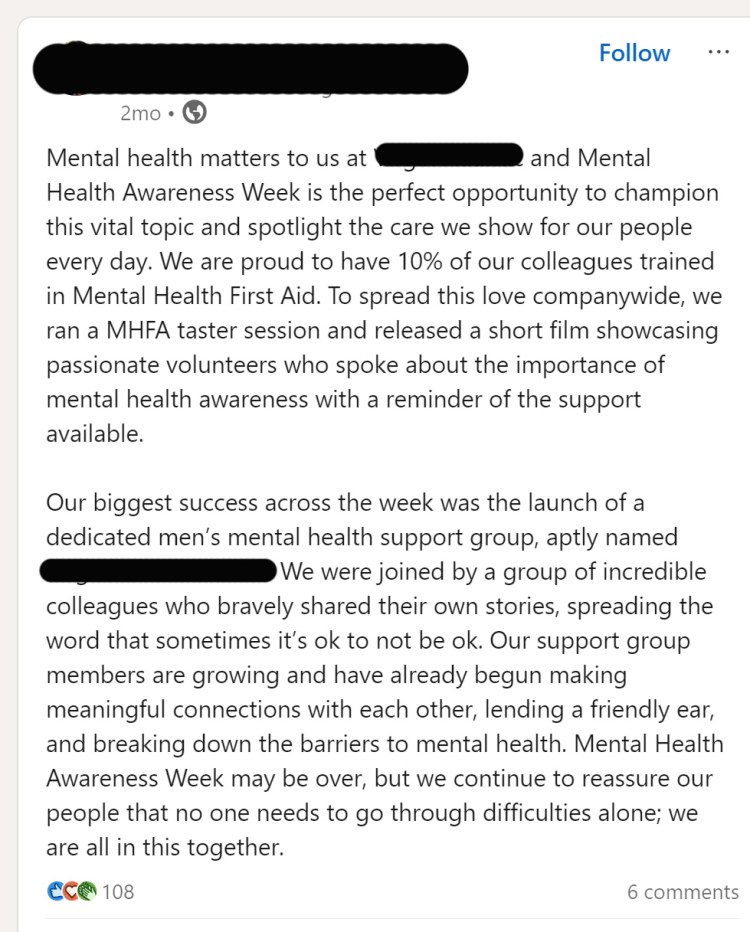
Here’s part of my reply :

Less than twenty-four hours after posting my reply, the person responsible for this post on LinkedIn, whose job title is “VP Total Reward airline name,” blocked me. Expecting that to be her response, I took screenshots of her post and my reply.
Returning to the grievance raised by ex-police officer Bart, the complaint that he submitted was rude, insulting, hateful, disrespectful and worse still, a pack of lies. Despite only being with the airline for eleven months and therefore still in probation, he made twenty complaints about my performance, ability and conduct. There wasn’t a single piece of evidence to substantiate any of his allegations. In documents submitted as part of my defence, I proved beyond reasonable doubt that everything he wrote was a lie.
The initial grievance investigation was carried out by Cabin Crew Manager Lana. Just a few years earlier, she had been a Flight Manager, the same rank as me. In 2014, she moved to a training job in the office and in November 2016, became a Cabin Crew Manager.
At the time of the investigation into Bart’s complaint, she had been in her position for just over two years. Although a nice person, she lacked the experience to deal with this matter. I now have good reason to believe that she was being influenced by the Head of Cabin Crew.
Our meeting took place on 9th April 2019. She left the business four months later but has since returned and is now a manager of a different department. I know that she’s read my story because she blocked me on LinkedIn. The reason for doing so is because, as you’ll see in a later chapter, I used information from her profile to question her ability to handle the case.
The meeting took place almost four months after my flight to Atlanta with Bart. Naively, I attended alone, confident that she would see through his lies. What quickly became apparent, however, was that every aspect of my role as a Flight Manager was being intensely scrutinised.
Having pointed out that Bart was an ex-police officer of eight years, yet everything in his complaint was a lie, Lana replied, “He’s not a police officer anymore.”
This next screenshot, from the minutes of that meeting, was the first time that I became aware that Bart was unhappy because he had not been given the opportunity to work up in the rank of Purser. The minutes, taken by an Employee Relations Consultant, were difficult to understand and did not accurately represent what I said.
I made many amendments, this is just one. “Briefing” refers to the Pre-Flight Briefing that takes place before the crew go to the aircraft. “Positions” refers to inflight working positions.

It’s important to remember that although Katrina had only been with the company for a few months longer than Bart, she had thirty years of flying experience, twenty as a Cabin Manager. Bart had been with the company for eleven months and had never flown as Cabin Crew before.
Had I not asked Katrina to work up as Purser, I would have asked Claire, who also had thirty years of flying experience and twenty years as an Onboard Manager (with her previous airline), or Lottie, who was the longest-serving crew member after me.
Upon returning home after what was an incredibly difficult and emotional day, I felt absolute despair. I called in sick the following day and was off for several weeks. For the first time in my life, I had been brought to tears while trying to defend myself from a pack of malicious lies.
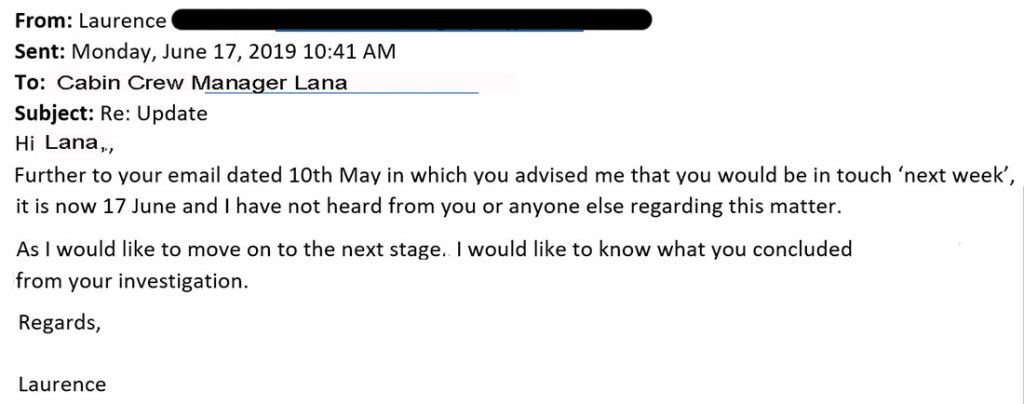
The outcome of Lana’s investigation consisted of one hundred fifty-six pages. It included witness statements from the operating crew, which I hadn’t seen previously. It also included minutes of her meeting with Bart, plus all correspondence associated with his complaint.
It was dated June 18, 2019. I joined the airline on June 18, 1990.
After reading every word on every page of this needless investigation, which had taken her ten weeks to complete, I was shocked to discover that four other crew members supported Bart’s allegations of inappropriate touching.
Something very strange was going on, but I didn’t understand what it was. It just didn’t add up. Why would four people who had been pleasant to fly with suddenly turn against me, and why would the company not believe a word that I said?
Having been advised that there was a case to answer, the matter was then passed to Cabin Crew Manager Hayley. She would conduct the next part of the process, the disciplinary hearing. She would look at the evidence for a second time and decide whether to uphold or dismiss Bart’s complaint.
My meeting with Hayley took place on August 15, 2019, almost seven months after my flight with Bart. This time, I was accompanied by an experienced Union rep. In addition to Hayley, an Employee Relations Consultant was also present, he had been in my first meeting with Lana. His purpose for being there was to take minutes and to ensure company procedures were followed. If necessary, he can ask questions to clarify anything that’s been discussed.
During my meeting with Lana, he was vocal throughout, and both of them questioned me equally. That made an already difficult situation even more stressful. We also had to change meeting rooms twice.
His minutes were difficult to read and full of mistakes, and those from the second meeting with Hayley were not much better. In all subsequent meetings that I attended, the Employee Relations Consultant only spoke to clarify something that had been said. Minutes from those meetings were clear and concise and needed almost no corrections.
Had Pedro (not his real name) spent more time taking minutes and less time trying to take the meeting, things may well have been different. According to his LinkedIn profile, he’s a “qualified solicitor in employment law with more than eight years experience.”
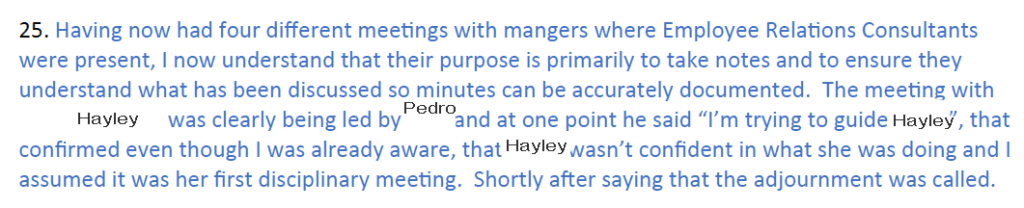
Not long after the meeting with Hayley began, it became clear that she had no idea what she was doing. Pedro was not only leading the meeting but was openly guiding her.
During a break that seemed to be called very suddenly, I said to the Union rep, “She has no idea what she’s doing.” Having raised this at the subsequent appeal meeting with the Head of Cabin Crew, she told me, “Hayley is a very experienced manager.”
In the outcome of my appeal, the Head of Cabin Crew wrote, “Hayley is a very experienced manager, but this was her first disciplinary meeting since joining the company.” She went on to say, “It was your perception that Pedro was leading the meeting.”
This comment was rude and disrespectful, considering she was not present and was not in a position to comment on how the meeting was conducted, especially considering it was Hayley’s first disciplinary meeting.
During the appeal meeting with the Head of Cabin Crew, the Union rep who accompanied me confirmed that it did appear as if Hayley was being guided. She also confirmed the meeting was being openly led by the Employee Relations Consultant. She went on to say that at one point, Hayley was reading from the wrong set of notes and had to be corrected. That wasn’t something I noticed. This experienced Union rep had attended many disciplinary meetings.
The following paragraph comes from minutes taken during the appeal meeting.
During the adjournment of my meeting with Cabin Crew Manager Hayley, the Union rep informed me there were many straightforward grievance matters that Hayley could have started with, so to give her a case of this complexity involving a Flight Manager was madness.
I now believe there was an underlying reason why she was given the case. The Head of Cabin Crew was the person who assigned grievances to Cabin Crew Managers. As my grievance progressed, it became obvious that she knew from the start what outcome she wanted. Since this was Hayley’s first grievance meeting since joining the company, understandably, she would have wanted to please her manager, and I’m sure the Head of Cabin Crew was available to give her plenty of guidance.
Hayley took six weeks to complete her investigation. During that time, she didn’t speak to Bart or any of the operating crew. All complaints against me were upheld, including one that Lana had already dismissed during the first investigation.
Having received the outcome, I submitted an appeal. My meeting with the Head of Cabin Crew took place on October 29th, 2019. I received the outcome eight weeks later.
I waited ten weeks to receive the outcome of Lana’s initial investigation and six weeks for Hayley to complete her investigation.
Regarding the second grievance in relation to the complaint from the CEO, I waited more than four weeks for the outcome of the initial investigation and six weeks for the outcome of the disciplinary hearing.
Having been told my appeal was not being upheld, I spoke to the government’s Advisory, Conciliation, and Arbitration Service about taking the matter to an industrial tribunal. They advised me that to do that, I would first need to file a grievance about how the Head of Cabin Crew had handled my appeal. I was also advised to file grievances against each crew member who I believed was telling lies.
After submitting the grievances to my manager, he told me that all seventeen Cabin Crew Managers were currently dealing with at least two disciplinary matters. Therefore, it’s likely to be some time before I hear back from anyone. I was genuinely shocked that so many grievances could be going on at any one time. When redundancies were announced shortly afterwards in response to Covid-19, any cabin crew member with a disciplinary was told their job was at risk.
This screenshot is from a conversation I had with the union rep who accompanied me to my meetings.

While off sick during the early days of COVID-19, before my employment came to an end, I learned that many crew were voicing concerns on the company’s communications platform about the amount of close contact they were having with customers during inflight services. Though I don’t know specific details, I’m aware the company disapproved of these discussions.
Subsequently, a new type of ‘verbal warning’ was introduced for those they felt were speaking out of turn. When redundancies were announced some weeks later, anyone with one of these warnings was told their job was at risk. Because it affected so many crew, the Union became involved and the decision was later overturned.
A good friend of mine, who had been in the company for longer than me, attended a grievance meeting after receiving one of these warnings. She described the experience as utterly terrifying and traumatic.
My grievance regarding the way the Head of Cabin Crew handled the appeal was sent to a senior manager. She passed it on to her manager because she advised me she would shortly be leaving the business. Her manager was the company’s Chief People Officer. Just days later, the situation with Covid-19 deteriorated and everything went into meltdown.
Several months after being made redundant, while browsing LinkedIn, the name of the Head of Cabin Crew popped up. She had also been made redundant. Having read her profile, what I saw was quite chilling. Everything suddenly began falling into place, or so I believed at that time.
While describing her responsibilities, she spoke about plans to improve employee engagement procedures to achieve expected business targets. She explained that she was responsible for implementing performance improvement plans with a focus on enhancing staff productivity.
I had been on long-term sick leave for eighteen months in 2016 and subsequently had a further three separate periods of sickness during my last twelve months while dealing with Bart’s spurious grievance.
Therefore, I believed at the time that my extensive sickness was the reason I was pushed out. With two final written warnings, I could be dismissed. Sometime later, I discovered that wasn’t the reason at all. The actual reason for this witch hunt was far more sinister.
The now-ex-Head of Cabin Crew also stated in her LinkedIn profile that she had recorded a significant reduction in cost for the business due to “restricting employee tribunal claims.” I wonder whether that had anything to do with my being made redundant.
I had been in the company for almost thirty years, during which time I had never received a warning regarding my performance. Yet, in less than a year, I had been given two disciplinaries, both instructed by the Head of Cabin Crew.
Although the second grievance regarding my tongue-in-cheek comment was upheld, the Cabin Crew Manager downgraded it from a final written warning to a written warning. In her outcome, she stated she did not feel it was appropriate for me to be dismissed. I believe that’s likely to be the only reason why I kept my job.
Just a few weeks later, I was told I was being made redundant. In my notification letter, it was claimed that part of the reason was my performance as a Flight Manager was below average. As I’ll demonstrate later in my story through company-issued documentation, nothing could have been further from the truth.
Life during my last twelve months in the company was not easy. The stress and anxiety I experienced are difficult to put into words. Returning to work in 2018 was a monumental achievement, but less than a year later, my mental health was worse than it had ever been.
Despite the constant battle to clear my name from Bart’s malicious lies, whenever I flew, I gave 100%. Neither my colleagues nor the customers I looked after could ever have imagined what I was going through.
This behaviour is not uncommon, especially for men, and it’s usually the reason why it comes as a shock when someone takes their own life. What makes this situation even more disgraceful is that the airline was fully aware of my struggles with mental health before, during and after the grievance raised by Bart.
In September 2020, I checked in for a flight to Miami. I didn’t go to this destination often and was looking forward to having breakfast on South Beach. What happened that day I will never forget.
About three hours into the flight, just after the lunch service in First Class had finished, I told the crew to have something to eat and went into the cabin to chat with customers. I suddenly felt very strange while talking to a lovely couple at the back of the cabin. I had never experienced anything like it before.
I excused myself and went to get some chocolate because I was really hungry and thought that might be the reason why I felt unwell. It made no difference and I was beginning to feel very light-headed. Upon reaching the galley, I asked a colleague for help.
Over the next four hours, the way that I felt continually changed. One minute, I was okay, but the next, I felt terrible. At times I was breathless, sweating and had mild pains in my chest. Despite the situation, I felt unusually calm and was super aware of everything going on around me. My priority was to prevent any disruption to the inflight service and to support my crew as best as I could to ensure the situation was handled correctly.
The Purser working in Economy came to the front to help and to get advice from the company’s medical team on the ground. With one Purser position recently having been made redundant, there was now only one Purser on each flight. The Flight Manager now ran the service in First, while the Purser ran the service in Economy.
When the afternoon tea service began, I could see things weren’t running smoothly. Therefore, I asked the Economy Purser to make an announcement apologising for any disruption to the service. He mentioned this in mandatory Performance Monitoring (performance feedback), that had to be completed on me towards the end of the flight.
I sat in the back galley for landing and walked off the aircraft before customers were released from their seats. While sitting on an ambulance bed at the top of the jetway, more than three hundred people passed by me. Thankfully, I was facing away from them.
I felt personally responsible for the service in First not running as smoothly as it should have. I always felt a strong sense of pride in the standard of service that was delivered on my flights.
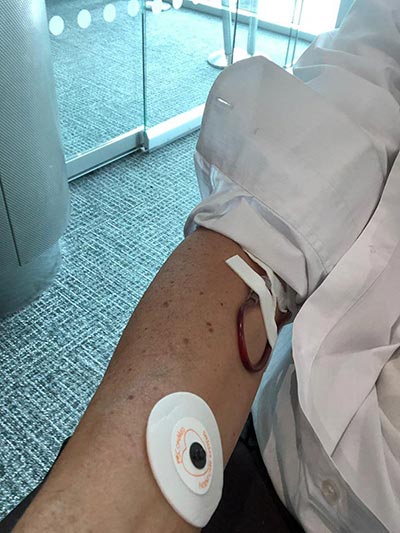
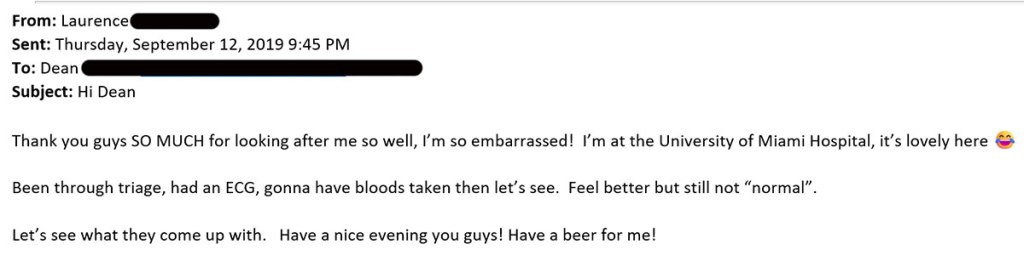
This email was a reply to the Economy Purser, who messaged me to ask how I was.
You may recall from earlier in this chapter that I mentioned that on my flight to Atlanta with Bart, there were no trained Pursers and that I was the only onboard manager. Due to the size of that aircraft, it still operated with two Pursers.
Now, imagine if I had been unwell on that flight. The next most senior crew member after me was Lottie, who was not a Purser. Although all cabin crew are trained to the same standard regarding safety and First Aid, Pursers and Flight Managers are on the flight for a reason. On that flight to and from Atlanta, eight out of eleven crew were still in or just out of their probation.
I spent the next nine hours in a hospital in Miami, and after numerous scans and tests, which turned up nothing, was discharged. I went to the crew hotel and crawled into bed, totally exhausted, at 1 a.m. local time. I’d been awake for well over twenty-four hours.
The following morning, the company’s medical team advised me to fly home as a passenger. Since there was nothing wrong with me, I insisted on working. There was no way I was going to let my team or the company down for a second time. I had been cleared to fly and worked home in my rank as a Flight Manager. I could have travelled home in a First-Class seat.
In hindsight, I believe what happened that day was a strange panic attack. What triggered it, I have no idea, but one thing I’m certain of was that it definitely had something to do with the enormous amount of stress I had been dealing with over the past nine months.
On the night flight home, I spent time speaking with one of the First Class crew. I had noticed her performance on the outbound sector before becoming unwell. After the situation kicked off, she stood out because she had been incredibly kind.
Once home, I wrote an email to her manager, something I had done many times over the years. A few months later, I received an email from her that brought a much-needed smile to my face. She had applied for promotion to Purser and had been successful. Sadly, the outbreak of COVID-19 a month or so later meant she never got to do her training course and was instead, made redundant.
This crew member and many others like her were part of the reason I stayed with the airline for thirty years. What a difference to the six vile degenerates who I had the misfortune of flying with on 24th December 2018.

 Being Cabin Crew | The Ugly Truth