
| Table of Contents Being Cabin Crew | The Ugly Truth Part 1 Page 1 – 2018 – My Return to Work Page 1 – Monitoring Performance Page 2 – My Performance Record Page 2 – Performance Feedback Page 3 – The Early Days… Page 4 – More from the Good Old Days Page 4 – Cabin Crew Life Downroute Page 4 – Pre-Flight Safety Briefings Being Cabin Crew | The Ugly Truth Part 3 |
My Performance Record
Have a look at the following two screenshots. Katrina, Lottie, and Claire, who worked alongside Bart and me in First Class, stated in their witness statement that they did not see and were not aware of any unusual behaviour between Bart and me at any time. Nor did they have any concerns about the way I conducted myself on or off the aircraft. Both the outbound flight and the inbound flight to the UK took around nine hours, and we had one night in Atlanta.
Claire and Katrina were best friends who had worked together at another airline before joining the company. They flew for thirty years and were onboard managers for twenty years. Lottie was an experienced crew member who had been flying for eight years.
Four or possibly five of the remaining eight cabin crew members colluded with Bart, and two failed to return their witness statements.

Bart mentions “not being engaging enough” because, in the performance feedback that I wrote on him, I addressed his lack of engagement when serving customers.
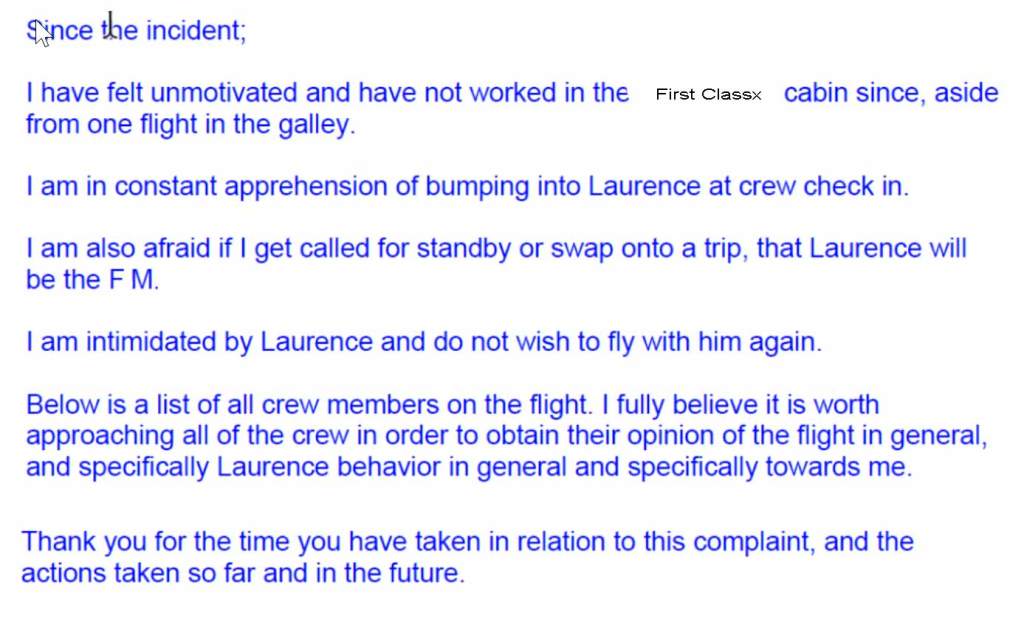
So, an ex-police officer who had served on a force in the North of England for eight years was afraid to fly with me again and felt intimidated by me. Yet, the three experienced crew members who worked alongside us on two long sectors were unaware of any unusual behaviour between us.
As you’ll see as you read on, with the exception of his ex-fiancée Anna, and Ven, nobody was aware of any unusual behaviour.
I appreciate that reading a performance appraisal completed on someone you don’t know is not very interesting. However, due to the subject being discussed, I feel it’s important and relevant to share the following assessment with you.
When I recently looked back at some old performance feedback, I saw that I was once given a “Needs Improvement” score for not wearing my tie. Thirteen years later, I addressed exactly the same issue with Bart.
Below are extracts from annual Performance Appraisals written on me by my manager in 2005 and 2006. Some airline terminology may not make sense, but it gives you an idea of the standard of my work.
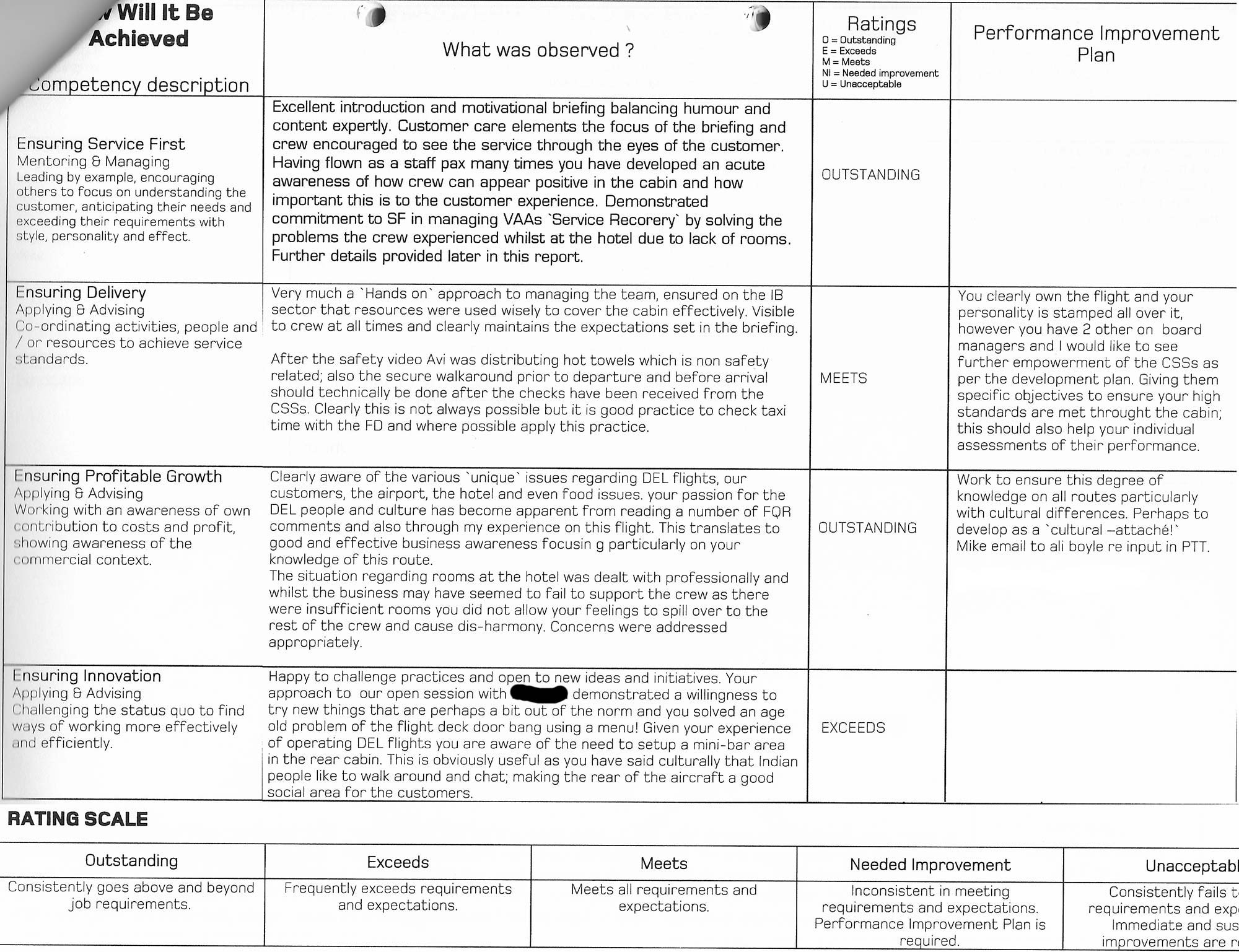
In the “Ensuring Effective Relationships” field below, my manager’s comment refers to a difficult situation I had to deal with involving an employee in a more senior rank. I’ll explain in more detail shortly.

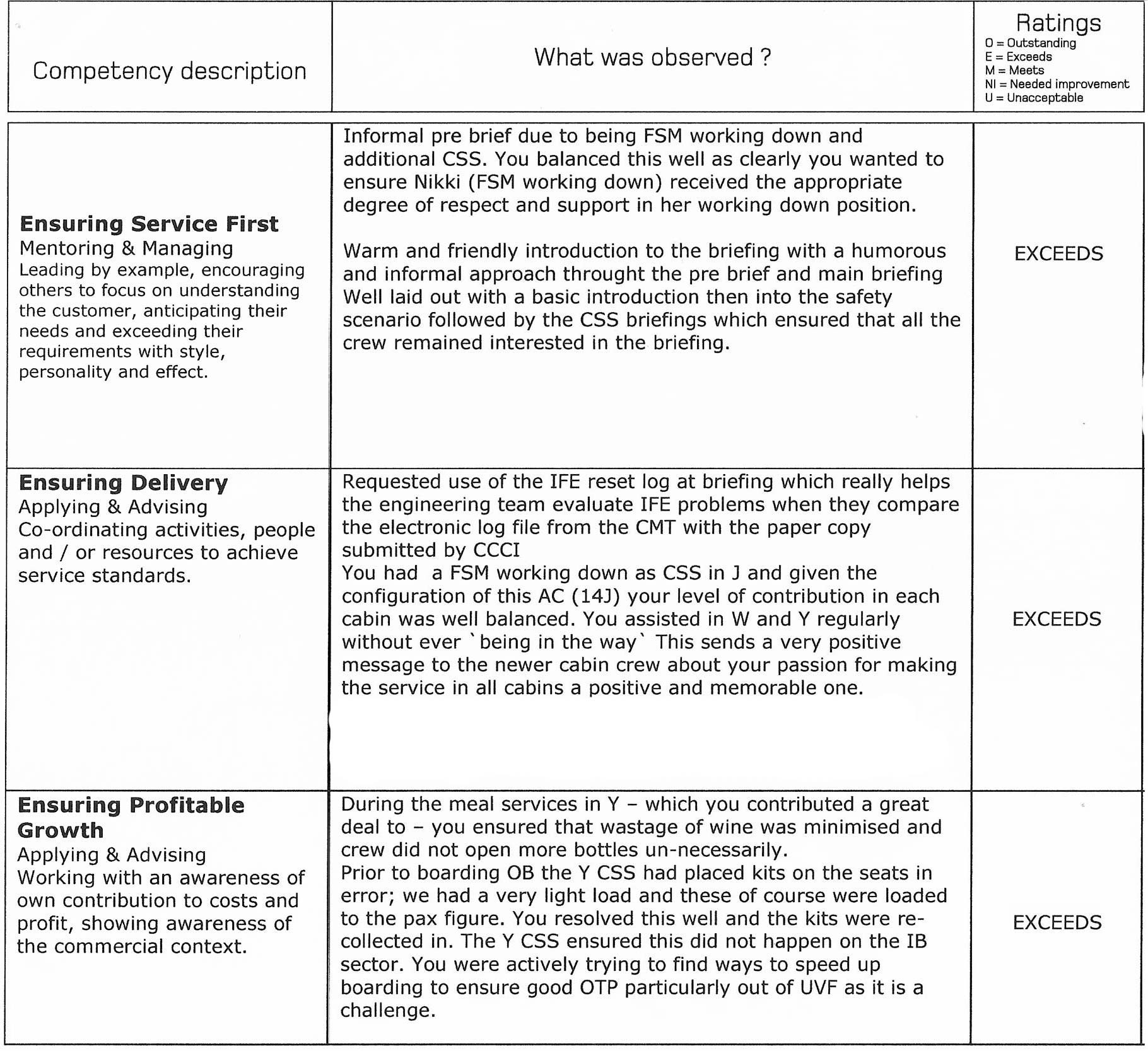
His comment in the “Ensuring Innovation” field regarding my onboard announcements is particularly relevant because, in the grievance raised by Bart and witness statements written by his fiancée Anna and Ven, they were critical and rude about them.
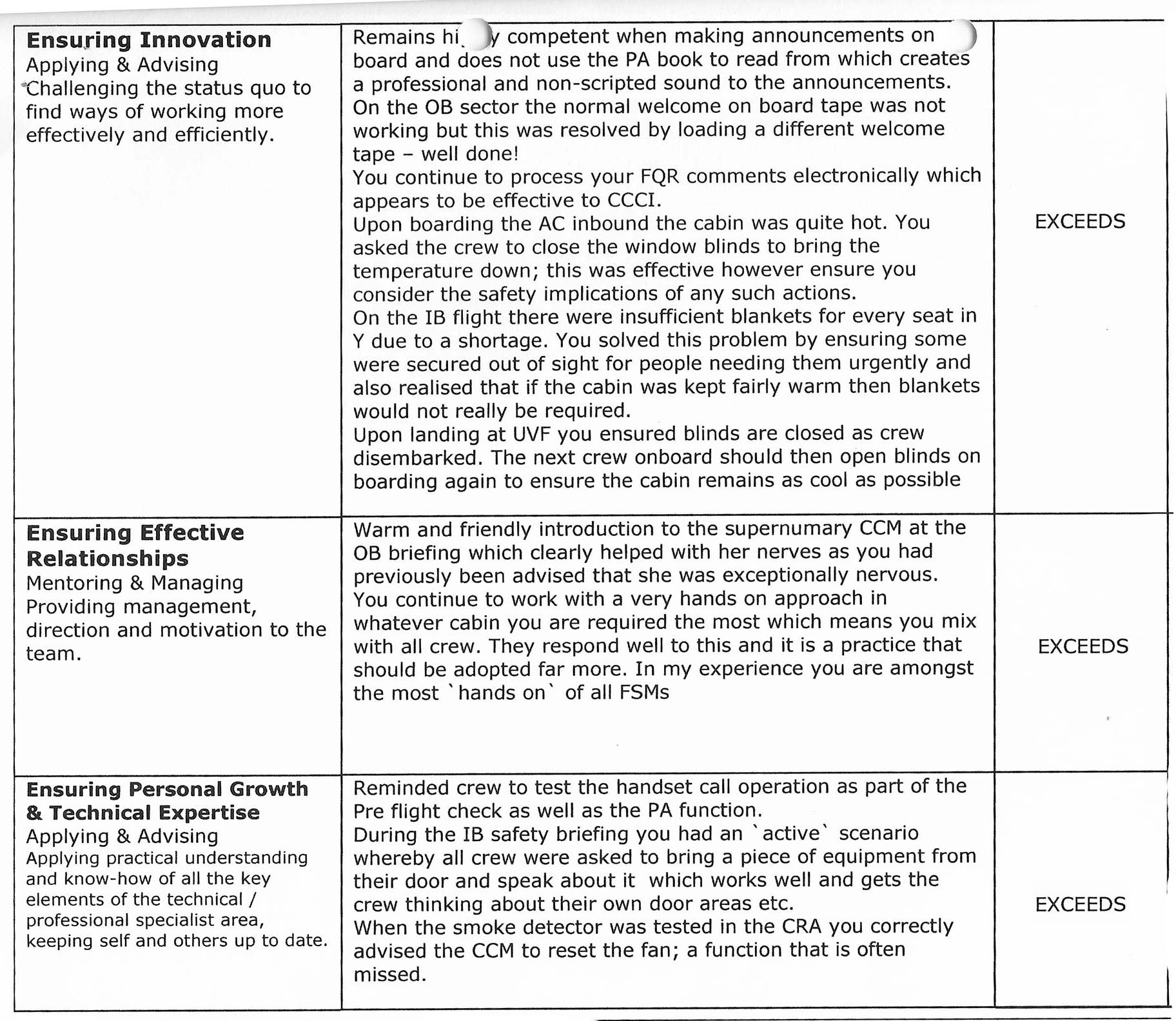
This is what happened regarding the situation mentioned in “Ensuring Effective Relationships” in the second screenshot.
Some months before this appraisal flight, I flew with a Delhi-based Cabin Crew Manager. She was on the flight as Cabin Crew to assess the performance of the local Delhi-based crew. She was relatively new to the company and it was her first time flying as Cabin Crew. She worked alongside them from the galley at the back of the aircraft.
During a busy lunch service, the Economy Purser rang me at the front to inform me this Crew Manager and a Cabin Crew member with whom she was friends, were messing around in the galley. It was affecting the service, and despite having spoken to them, they were not taking any notice.
I spoke privately with the Cabin Crew Manager, but she didn’t take kindly to the issue being addressed. After returning home, she reported me to my manager.
When my manager flew with me on this appraisal flight, he arranged for her to be part of the crew.
I learned from removing my tie while on the transport to the hotel and never did it again. The Performance Appraisal that included this comment was written in 2005.
When I flew with Bart in 2018, I noticed that he removed his tie before walking through the cabin, past customers, to the Cabin Crew Rest Area (CRA) to start his rest break. I didn’t address it with him at the time, not because I was avoiding doing so, but because I had forgotten about it by the time he returned from his break two hours later.
In the following screenshot, you’ll see my comment from the performance feedback that I wrote on him (black text) and the response in his grievance. It’s important to mention that the cabin crew are always woken up ten minutes before the end of their rest break. This gives them enough time to freshen up and be back in the cabin before the crew on the second break go for their rest.

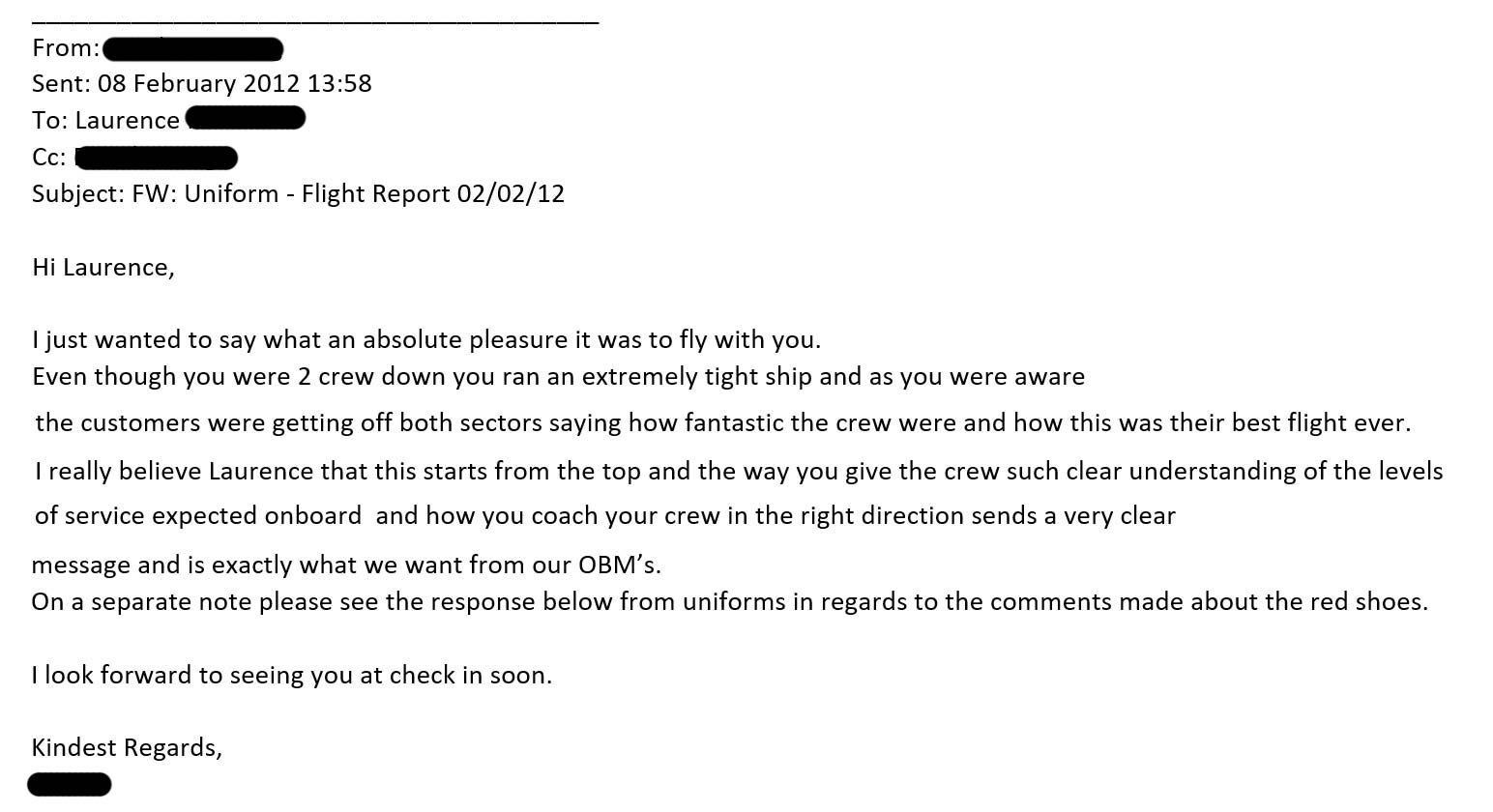
In 2012 I had been a Flight Manager for eleven years. Having flown with a Cabin Crew Manager on one of my flights and spoken to her about an ongoing issue with the female Cabin Crews’ uniform shoes, I received the following email from her after the flight. OBM is an abbreviation for onboard manager. You’ll notice that once again, we were operating ‘crew down.’
As I mentioned in an earlier chapter, the company advised me that I was being made redundant not solely because of the two disciplinaries on my file but also because my performance was below average.
Performance Feedback
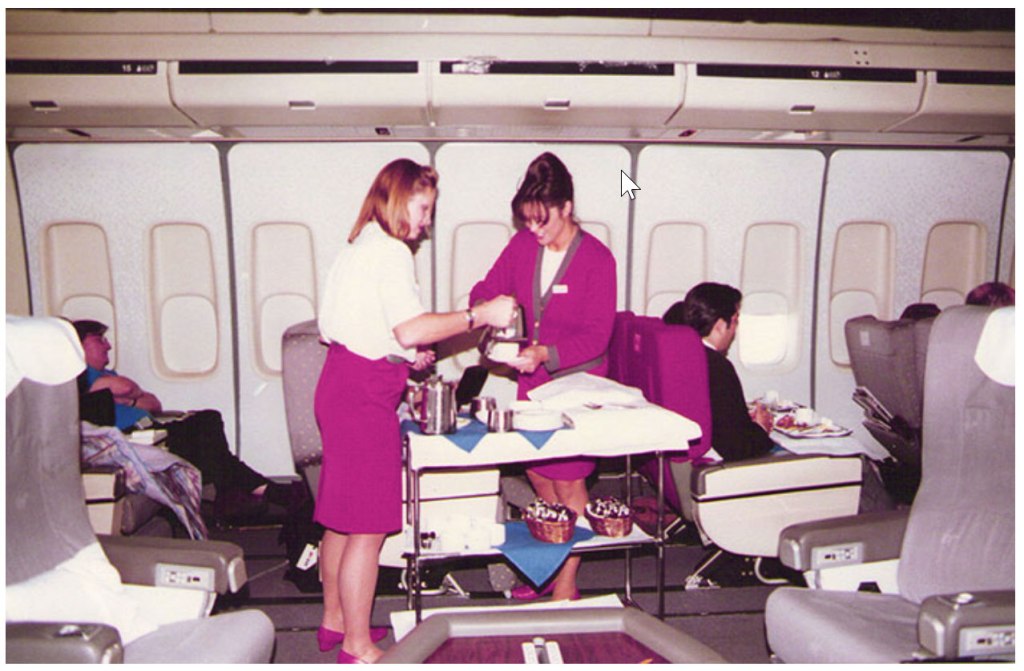
Since the airline’s first flight, there had always been a Junior and Senior rank. Juniors worked in Economy and Seniors worked in First Class.
The length of time spent in rank varied greatly. Promotion, including to Purser and Flight Manager, would suddenly appear on your roster. When more crew in a higher rank were required, you’d be rostered to the appropriate training course. Promotions were done according to ‘date of joining’, meaning the date you joined the company.
Just before I applied for Purser in 1996, the system changed to an application and interview process. This was applicable for Senior Cabin Crew to Purser and Purser to Flight Manager. Around 2012, another change was implemented, this time for the Junior Cabin Crew. So instead of Juniors being automatically promoted to Senior, they now had to submit an application for the role.
In 2018, just before I returned to work after being on long-term sick leave, the company made the Senior Cabin Crew rank redundant. The new rank, known simply as Cabin Crew, meant that any crew member could work in any of the three cabins on the aircraft.
The Flight Manager and Purser, who are both classed as onboard managers, have always been required to complete performance feedback on the cabin crew towards the end of each sector.
In 2018, the system changed so that the Cabin Crew were now also required to complete upward feedback on the Onboard Manager they were working with.
In Economy, one crew member had to write feedback on the Purser, while the Purser completed feedback on all crew members working in Economy. In First Class, the Purser completed feedback on the crew in that cabin, as well as on the Flight Manager. One crew member in First Class had to write upward feedback on the Flight Manager, while the Flight Manager completed feedback on both Pursers and on one crew member in First Class.
In addition to writing feedback, a grade also had to be given. It was initially out of ten but was then changed to five. All performance monitoring was completed on newly issued company iPads.
The performance feedback was shared with flying staff quarterly. The system was designed to be anonymous, so any details that identified who had written the feedback and on which flight were removed.
The iPad app only had space for two short paragraphs of text. When I raised a concern about the amount of space with the respective office-based manager, I was told that if more detailed feedback was required, it should be completed on paper.
Along with a recently introduced ‘Voice of the Customer programme’, the airline believed they now had an accurate tool for assessing the performance of all Cabin Crew and Onboard Managers.
A Voice of the Customer programme collects feedback about a product or service. Armed with this information, the business can work towards creating a better customer experience. The airline then developed an algorithm which enabled them to produce a score to rank the performance of each crew member and onboard manager. The score for onboard managers came partly from Voice of the Customer feedback and partly from the anonymous performance feedback written on them by the cabin crew.
The Voice of the Customer feedback came from a questionnaire that was emailed to each passenger soon after they landed.
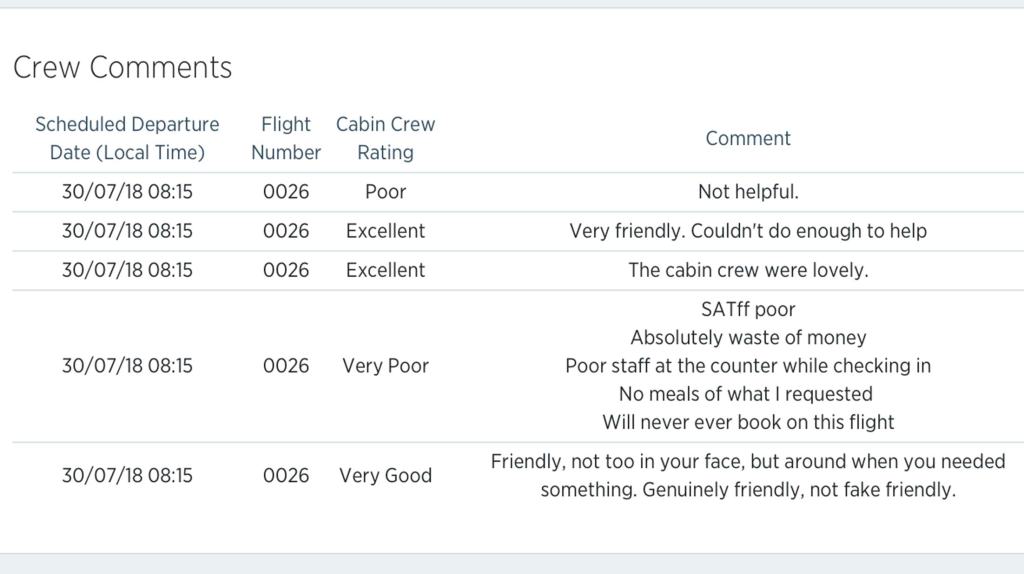
Here’s an example of feedback that I received after one of my flights. These customers could have been sitting anywhere on the aircraft and may not have had any contact with me personally during the flight.
They would not have known that their comments or scores were being used to assess an onboard manager. When asked about the onboard service, they would have based their feedback on the service they received from the crew members serving their section, whether that was First Class, Business, or Economy.
Most Flight Managers spend the majority of the flight in First Class and also do one service in the Business cabin. Some, like me, also spend time in Economy, although there is no requirement to do so.
Scores from the Voice of the Customer surveys were used, in part, to decide who would keep their jobs and who would be made redundant in response to redundancies caused by the COVID-19 pandemic.
In the months after this programme was launched, the “Cabin Crew Rating” and “Comment” sections of questionnaires completed by customers who travelled on the outbound flight were made available for onboard managers to share with their crew during the pre-flight briefing for the inbound sector. The comments were not censored, and some were highly offensive. The crew were often blamed and given low scores for problems totally out of their control.
One “very poor” rating I received came from someone sitting at an emergency exit. The customer complained about not being able to use his laptop during take-off and landing. This is not permitted in accordance with UK Civil Aviation Authority regulations.
Another was from a customer I had spoken to personally about a dietary meal that had not been loaded. Despite spending considerable time with him and resolving the problem as best as I could, he marked the crew “very poor”. Poor and very poor ratings brought performance scores down considerably.
Cast your mind back to the last chapter, when I spoke about the customer sitting at the front of the Business cabin who had been repeatedly asking for an upgrade. Imagine what score she would have given had she received a Voice of the Customer Questionnaire.
The following screenshot is my performance scorecard for the first period after I returned to work after being on long-term sick leave in March 2018. My score from Voice of the Customer (VoC) is 66.28%. The score from performance management (PM), which is upward feedback written anonymously by the crew, is 8.91%. So, my total score is 77.67%. That means my performance was 5.67 percentage points above average.

In the next quarter, my scores dropped slightly but were still above average. Everyone’s scores fluctuated depending on the destination, the age of the aircraft (because that affected facilities such as wifi and inflight entertainment) and problems encountered during the flight.
When I was notified in June 2020 that I was going to be made redundant, I was informed that part of the reason was my below-average performance scores.
The company stated that it would use the period from April 1, 2019, to March 30, 2020, to compile performance scores to decide on redundancies. When they were first announced, I was on long-term sick leave. I had been off since December 20, 2019.
The scorecard above covers October, November, and December 2018 and shows that I was well above average. My scorecard for January, February, and March 2019 also indicates above-average performance. Yet from April to December 2019, my scores were apparently below average.
From September 2019, I only operated flights to Tel Aviv because I was part of the Core Crew operating this new route. Given that it was a new destination, performance scores were lower than on most other routes. According to the manager of the Product and Service Delivery department, customer feedback is always lower on a new route for the first few months due to teething problems.
During 2019, while dealing with Bart’s grievance, I had three significant periods of sickness that amounted to about eight weeks. The company stated that if they could not gather enough feedback to produce a fair score due to sickness absence, they would extend the assessment period beyond April 1, 2019. Printed scorecards like the one above confirm that I was an above-average performing Flight Manager throughout 2018 and until at least March 2019.
I had been an above-average employee for the best part of thirty years, as evident from performance feedback written throughout my employment. Yet suddenly, within the space of a few months, I was underperforming to such a degree that along with the two disciplinaries that I received within a few months of each other, I was being made redundant.
Many months later, when speaking with a solicitor, I was advised that using sickness as a reason for making someone redundant is a grey area. Selection for redundancy should be based on fair and objective criteria relevant to the needs of the business. While attendance and disciplinary matters can be considered, this must be done fairly and consistently. I believe the company claimed I was an underperforming Flight Manager to substantiate their decision to make me redundant.
A few weeks after learning that I was being made redundant, I received this award in the post. It came with a golden lapel pin to wear on my uniform. A uniform I hadn’t worn for several months because I was still off sick and wouldn’t be wearing again before my employment was terminated.
I also received a “congratulations” card signed by the CEO. The same CEO who reported my tongue-in-cheek comment to the Head of Cabin Crew, which led to a second disciplinary.

I couldn’t believe what was printed in the bottom left corner of this clear Perspex ‘award.’
These are obviously used at different award ceremonies and the company just changes the text to suit the event. As if sending this to someone who had just been told he was being made redundant wasn’t bad enough, above my name was the word “winner”. That’s not appropriate even if I wasn’t being made redundant. After what I had been through over the last twelve months, I was anything but a winner.

This card accompanied the plaque. The CEO’s name was printed in block letters at the bottom of the card. While I appreciate it may not have been possible for him to sign it personally, a reproduced copy of his signature may have felt more genuine, and it really wasn’t necessary to put “CEO” after his name.
The Perspex plaque, this card, and my P45 were all I received for thirty years of loyal service to the company.


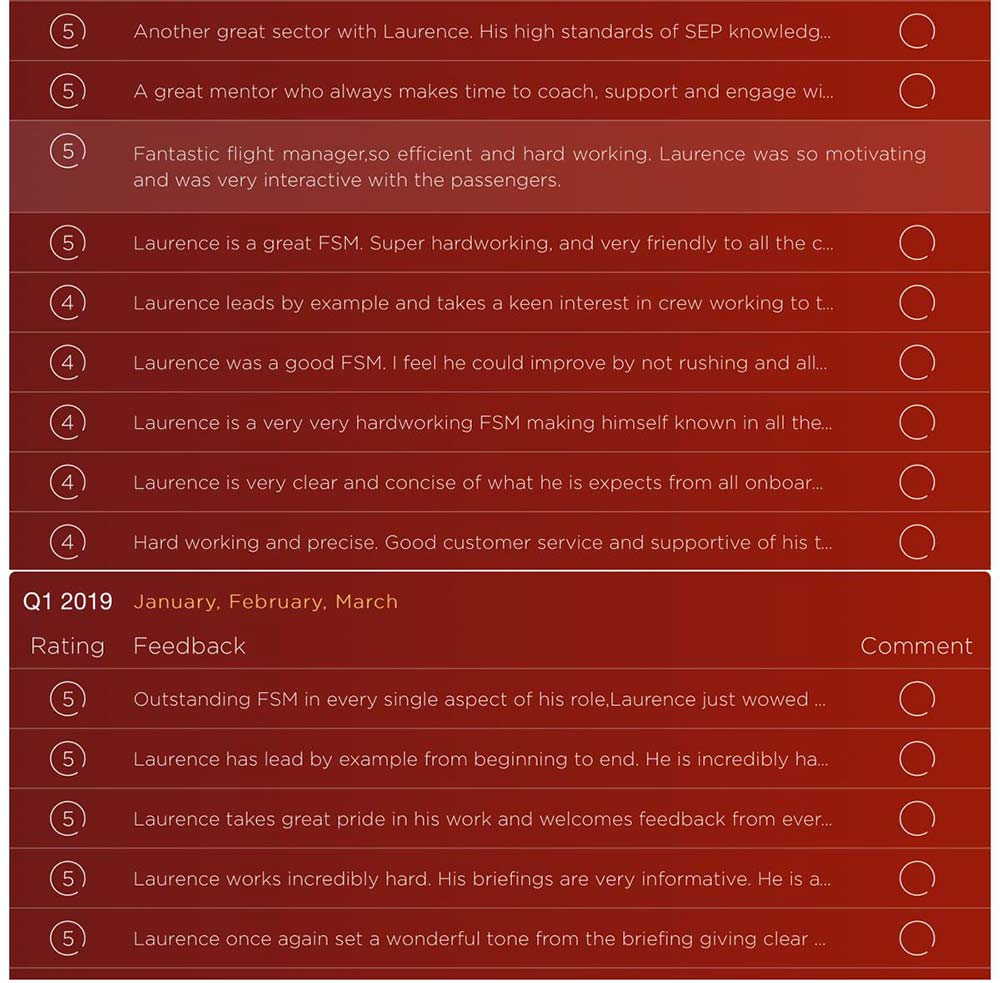
To close this chapter, I want to include some extracts from upward performance feedback written on me anonymously by colleagues I flew with during my last eighteen months as a Flight Manager.
Scores are out of 5. We received these reports on our iPad every three months. The comments are enclosed in a dropdown box, so for most, you’ll only see the first line, but it’s enough to give you an idea of what is being said.
Not bad for an underperforming manager who had been in rank for nineteen years.
Click each image to open it in full size.


 Being Cabin Crew | The Ugly Truth